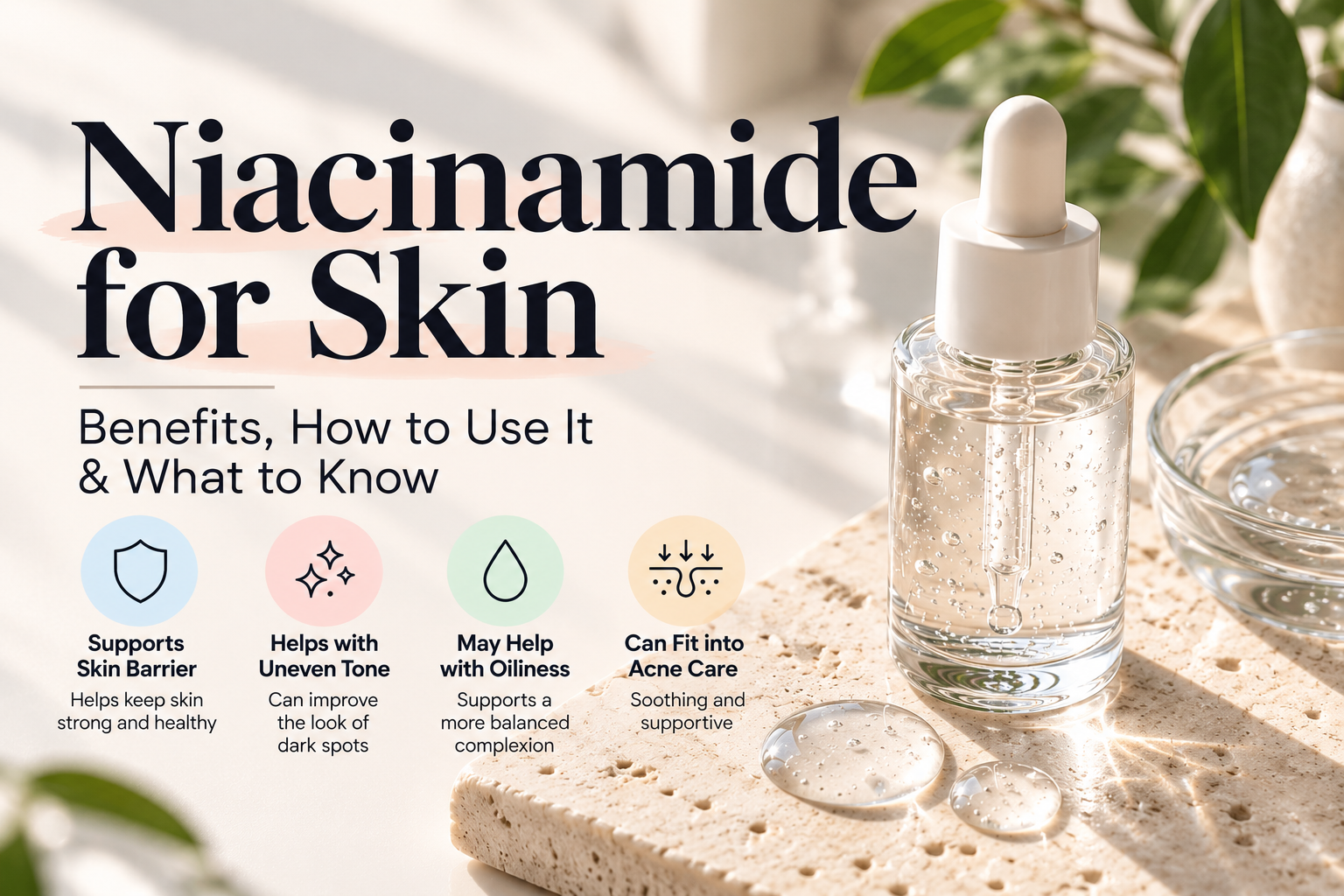
Niacinamide for Skin: Benefits, How to Use It & What to Know
Niacinamide for skin has become one of those ingredients that seems to appear everywhere—from simple hydrating serums to products designed for oily skin, uneven tone and barrier support.
But popularity also creates confusion.
Do you need 10% niacinamide? Is 5% enough? Can you use it with vitamin C or retinol? And if you already use several active ingredients, does niacinamide actually add anything useful to your routine?
The good news is that niacinamide is not simply a social-media trend. It has been studied in topical skincare for years, including research involving skin barrier function, pigmentation and other aspects of skin appearance.
That doesn’t mean everyone needs a high-strength niacinamide serum, though.
Here’s what the evidence suggests—and how to use niacinamide without making your routine unnecessarily complicated.
What Is Niacinamide?
Niacinamide, also called nicotinamide, is a form of vitamin B3.
In skincare, it is used topically in products such as serums, moisturizers and treatments.
One reason it has become so common is its versatility. Rather than targeting only one skincare concern, niacinamide has been studied in several areas, including skin barrier function, pigmentation and sebum-related concerns.
It is also relatively easy to incorporate into a routine because it appears in many different types of formulations.
But the percentage on the front of the bottle isn’t the only thing that matters.
Niacinamide for Skin: What Are the Benefits?
It can support the skin barrier
One of the more established reasons niacinamide is used in skincare is its relationship with skin barrier function.
The skin barrier helps limit excessive water loss while protecting the skin from the external environment.
When that barrier isn’t functioning well, skin may feel dry, tight or uncomfortable—even when the surface also becomes oily.
Niacinamide has been studied for its effects on components involved in barrier function, which is one reason it appears so frequently in moisturizers and barrier-focused formulas.
If your skin frequently feels tight after cleansing or seems both oily and dehydrated, the ingredient may make sense as part of a broader routine rather than as a standalone solution.
Related: Oily but Dehydrated Skin: Why Your Face Feels Greasy and Tight
It may help with uneven-looking pigmentation
Niacinamide has also been studied for hyperpigmentation.
Its mechanism is different from ingredients that directly inhibit melanin production. Research suggests niacinamide can interfere with the transfer of melanosomes—the structures containing melanin—from melanocytes to surrounding skin cells.
Clinical studies using topical niacinamide have reported improvements in hyperpigmentation and uneven-looking skin tone.
That doesn’t mean it will erase every dark spot, and pigmentation can have many causes. But it helps explain why niacinamide frequently appears in brightening skincare.
It may help with oiliness
Niacinamide is also commonly marketed for oily skin.
There is some evidence suggesting topical niacinamide may influence facial sebum levels, although this area has less extensive evidence than some of its other uses.
This is also where expectations matter.
Niacinamide doesn’t need to make skin completely oil-free to be useful. Sebum is a normal part of healthy skin.
For oily or combination skin, the goal is usually a comfortable, balanced routine—not eliminating oil altogether.
It can fit into acne-prone skincare
Niacinamide also has anti-inflammatory properties and has been investigated in acne-related skincare.
However, I wouldn’t treat a cosmetic niacinamide serum as a replacement for established acne treatments when someone has persistent or significant acne.
Think of it more as a potentially useful supporting ingredient within a well-designed routine.
Is 10% Niacinamide Better Than 5%?
This is probably one of the most useful questions to ask before buying a niacinamide product.
Skincare shelves now contain formulas with 10%, 15% and sometimes even higher concentrations.
That can create the impression that:
higher percentage = better results
The evidence doesn’t support making that assumption.
Clinical research has reported benefits from formulations containing concentrations such as 2% and 5%, depending on what researchers were studying.
That doesn’t mean 2% or 5% is the universally perfect concentration either. Different studies use different formulations, populations and outcomes.
What it does tell us is that you don’t automatically need 10% simply because a higher number sounds stronger.
For someone new to niacinamide—or someone whose skin becomes irritated easily—a moderate concentration in a well-formulated product can be a perfectly reasonable place to start.
If you already tolerate a 10% product well, there is no automatic reason to stop using it.
The important point is simply this:
Don’t choose niacinamide based on percentage alone.
The overall formula, how often you use it and how your skin responds matter too.
How to Use Niacinamide in Your Skincare Routine
Niacinamide is relatively flexible.
A basic routine might look like:
Morning
Cleanser
→ Niacinamide serum
→ Moisturizer
→ Sunscreen
Evening
Cleanser
→ Niacinamide serum
→ Moisturizer
But you don’t have to follow that exact sequence if your niacinamide is already included in another product.
For example, if your moisturizer already contains niacinamide, adding a separate high-concentration serum may not be necessary.
I generally prefer keeping routines purposeful rather than adding another active simply because it is popular.
If you’re unsure where different products belong, I explain the basic order here:
How to Layer Skincare Products: The Right Order for Morning and Night
Should You Use Niacinamide in the Morning or at Night?
Either is fine.
Unlike ingredients that are usually associated with a particular time of day, niacinamide can generally fit into a morning or evening routine.
Some people use it once daily. Others use products containing it twice daily.
There isn’t a requirement to use it as often as possible.
Choose the frequency that fits your routine and skin tolerance.
Personally, I tend to use niacinamide as part of my evening skincare.
Over time, my overall routine has coincided with fewer breakouts, less excessive oiliness and more consistent skin condition for me.
But I wouldn’t attribute those changes to niacinamide alone. My cleansing, moisturizing and overall consistency changed as well.
That’s an important distinction whenever we talk about personal skincare results.
Can You Use Niacinamide With Vitamin C?
Yes, in general.
The idea that vitamin C and niacinamide can never be used together is largely an outdated skincare rule.
Modern cosmetic formulations can contain both ingredients, and they don’t automatically cancel each other out when applied in the same routine.
However, that doesn’t mean everyone needs to layer separate niacinamide and vitamin C serums.
If your skin tolerates both, they can fit into the same routine.
If layering several active products causes irritation, you could simplify things—for example, using vitamin C in the morning and niacinamide at night.
That isn’t because the ingredients are fundamentally incompatible. It’s simply one way to keep a routine manageable.
I go into vitamin C in more detail here:
How to Use Vitamin C Serum: Benefits, Vitamin E & Ferulic Acid
Can You Use Niacinamide With Retinol?
Niacinamide can also be used in a routine that contains retinol.
In fact, because niacinamide is commonly used in barrier-supportive formulations, the combination can make practical sense.
But again, more products don’t automatically create better skin.
If you’re introducing retinol for the first time, I would generally prioritize learning how your skin responds to the retinol before simultaneously introducing several new actives.
That makes it much easier to identify what is causing irritation if something goes wrong.
What About Azelaic Acid or Tranexamic Acid?
Niacinamide can also appear in routines alongside ingredients such as azelaic acid or topical tranexamic acid.
The bigger question isn’t simply:
“Can these ingredients be mixed?”
It’s:
“Do I actually need all of them?”
If pigmentation is your main concern, for example, several ingredients in your routine may target overlapping problems through different mechanisms.
Using every brightening ingredient you can find isn’t necessarily better than choosing a smaller number of products that your skin tolerates consistently.
This is particularly important for people who become excited about active ingredients and end up changing several parts of their routine at once.
Can Niacinamide Irritate Your Skin?
Niacinamide is generally considered well tolerated in topical skincare, but irritation is still possible.
Some people report:
- redness
- itching
- stinging
- dryness
- general irritation
This may be related to concentration, the overall formulation or another ingredient in the product rather than niacinamide itself.
If you’re trying a new product, especially a high-concentration serum, starting gradually can make it easier to see how your skin responds.
Persistent burning, significant redness, swelling or worsening irritation is a reason to stop using the product and reassess.
What I Would Check Before Choosing a Niacinamide Product
I wouldn’t automatically choose the bottle with the biggest percentage printed on the front.
Instead, I would look at:
The concentration
You don’t necessarily need an extremely high percentage to benefit from niacinamide.
The overall formula
A serum containing niacinamide alongside hydrating or barrier-supporting ingredients may fit some routines better than a very concentrated single-active formula.
What your routine already contains
Niacinamide appears in many toners, essences, serums and moisturizers.
You may already be using it without realizing it.
Your actual skin concern
Are you trying to support your barrier?
Manage oiliness?
Improve the appearance of post-acne marks?
Or are you buying niacinamide simply because you’ve heard everyone should use it?
Starting with the problem makes choosing skincare much easier.
Do You Actually Need Niacinamide?
Not necessarily.
Niacinamide is a useful and well-established skincare ingredient, but no single ingredient is mandatory for healthy skin.
If your current routine already works well, you don’t need to add niacinamide simply because it’s popular.
But if you’re looking for an ingredient that can fit into a relatively simple routine while addressing concerns such as barrier support, uneven-looking tone or oiliness, niacinamide is worth considering.
And you probably don’t need to chase the highest percentage available.
A formula your skin tolerates—and that you can use consistently—is usually much more useful than an impressive concentration that leaves your skin irritated.
For me, that’s become one of the most important lessons in skincare:
Choose products around what your skin actually needs, not around the biggest number or the loudest trend.