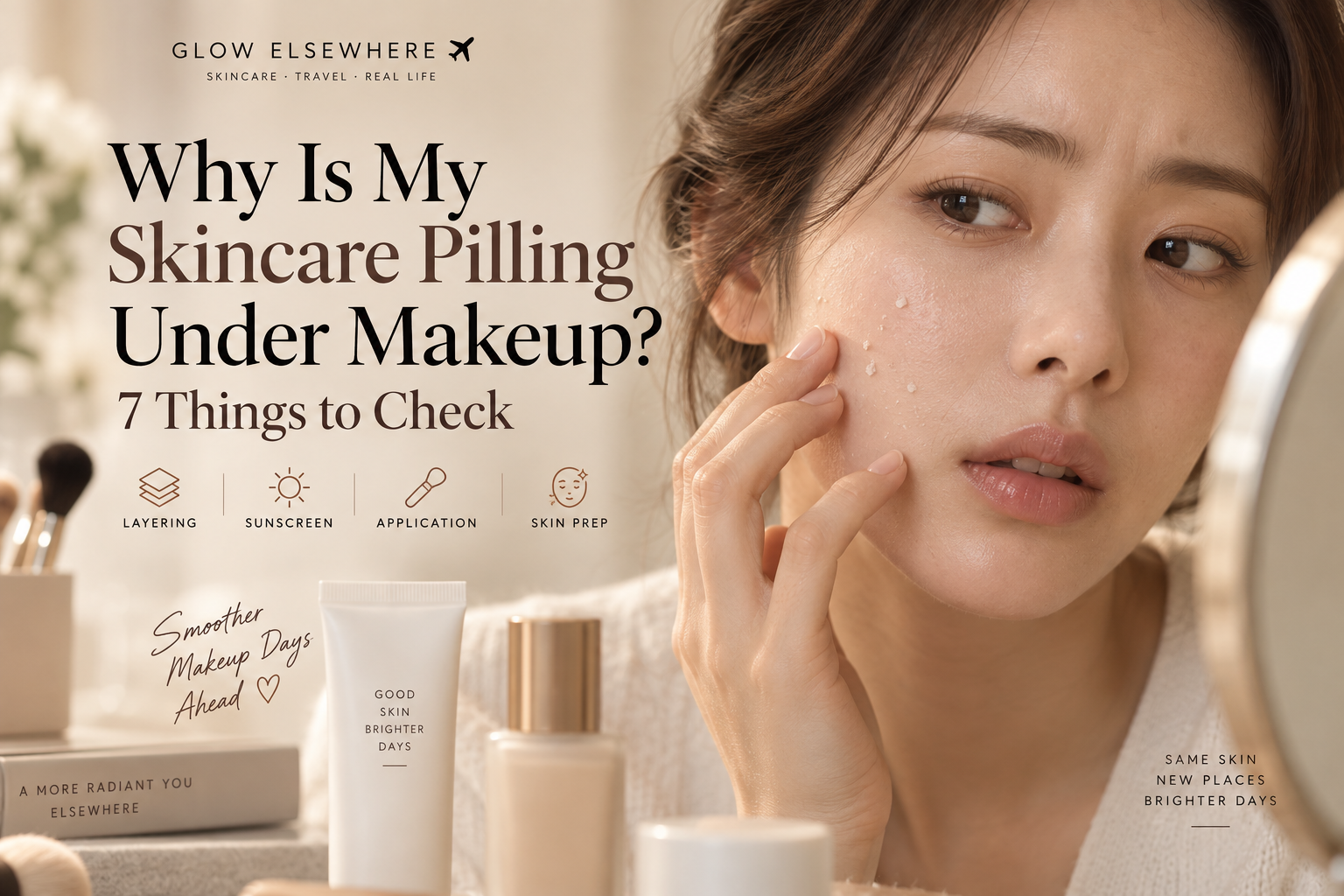
Why Is My Skincare Pilling Under Makeup? 7 Things to Check
Skincare pilling under makeup can turn an otherwise good routine into a frustrating mess.
You apply your serum, moisturizer and sunscreen. Everything seems fine—until foundation goes on and tiny flakes or little rolls of product start appearing across your skin.
I’ve dealt with this myself, especially when I was trying to figure out how much skincare my skin actually needed before long hours of makeup.
What helped wasn’t simply buying different products. I started paying more attention to how much I was applying, how I layered everything and how I applied makeup on top.
If your skincare keeps pilling under makeup, here are seven things worth checking.
First, What Is Skincare Pilling?
Pilling happens when skincare, sunscreen or makeup begins to roll or clump into small flakes or balls on the surface of your skin.
It can look a little like peeling skin, but the material you’re seeing may actually be product rolling up rather than skin itself.
And it doesn’t automatically mean your skin is “rejecting” a product.
Research into cosmetic pilling is still limited, but a 2024 study involving 528 women found that skin characteristics, the products being layered and application technique may all influence whether pilling occurs.
So instead of immediately blaming your foundation, look at the entire routine underneath it.
1. You May Be Applying More Product Than You Need
More skincare isn’t always better before makeup.
Several generous layers of serum, moisturizer, sunscreen and primer can leave a lot of material sitting on the surface of the skin.
Once you start applying foundation, the additional movement and friction may make some of those layers roll up.
I’ve experienced this with moisturizer.
There was a period when I was trying so hard to prevent dryness during flights that I applied too much cream before makeup. Instead of making my base look better, it sometimes made my makeup move or pill.
Now I aim for enough moisturizer to keep my skin comfortable without automatically applying the thickest layer possible.
This is also why the “right” amount can depend on your skin, your moisturizer and what you’re putting on top of it.
2. Too Many Layers May Be Working Against You
If your routine looks like:
toner → essence → serum → ampoule → moisturizer → sunscreen → primer → foundation
there are a lot of different formulations interacting on the same surface.
That doesn’t mean layering multiple products is inherently bad.
But if you’re experiencing pilling, simplifying the routine can help you identify the problem.
Try removing one optional step at a time rather than replacing everything at once.
For example, if your makeup sits well over moisturizer and sunscreen but starts pilling when you add another serum or primer, you’ve learned something useful about that particular combination.
Think of it as troubleshooting rather than assuming you need an entirely new routine.
3. Your Sunscreen May Be the Layer Where Pilling Starts
If everything looks fine until sunscreen goes on, pay attention to that step.
In the 2024 study, most of the observed pilling events occurred after sunscreen was applied over a base skincare product. The researchers also found that different base formulations produced different pilling results.
That doesn’t mean sunscreen always causes pilling or that you should simply use less of it.
It means the way your sunscreen interacts with the products underneath it may matter.
If you’re troubleshooting, try the sunscreen on simpler skincare underneath and see whether the problem changes.
And don’t solve pilling by drastically reducing sun protection just to make foundation look smoother.
4. You May Be Rubbing the Layers Too Much
How you apply your products can matter too.
In the same study, rubbing products in linear or circular motions was associated with more observed pilling events than other application methods tested.
That makes friction worth paying attention to.
If your skincare looks fine until you repeatedly rub foundation over it, try using less movement.
Rather than aggressively working each layer back and forth across your face, apply it more gently.
With makeup, pressing or tapping your base into place may work better for some product combinations than repeatedly dragging it across the skin.
You don’t need to treat this as a universal makeup rule. It’s simply an easy variable to test when pilling keeps happening.
5. Give Your Routine a Chance to Settle
You don’t necessarily need to stand around with a timer between every skincare step.
But immediately stacking several wet or heavy layers and then rubbing makeup over them can make the whole routine harder to work with.
Personally, I do my skincare first and continue getting ready before applying makeup.
That naturally gives my skincare some time to settle without me deliberately timing it.
If your face still feels very wet, slippery or coated when you reach for foundation, try giving the routine a little more time before adding another layer.
The important part isn’t finding a magical number of minutes.
It’s noticing how the products actually feel on your skin before you continue.
6. Don’t Assume Every Formula Combination Will Behave the Same
You’ll often see rules online such as:
“Never mix water-based and silicone-based products.”
Real-life formulations are more complicated than that.
Most cosmetic products contain combinations of ingredients, and current research on pilling isn’t strong enough to reduce the problem to one universal ingredient-pairing rule.
The 2024 study found that different skincare formulations produced different pilling patterns even when used with the same sunscreen.
So if two products consistently pill together, it’s reasonable to change the combination.
But you don’t necessarily need to reorganize your entire routine based on whether the first few ingredients appear to be “water-based” or “silicone-based.”
Testing the actual products together is more useful.
7. Check the Condition of Your Skin Too
Sometimes the products aren’t the only thing worth looking at.
In the study, participants who experienced certain types of pilling differed in measurements including skin hydration, oiliness, pH and texture. The researchers concluded that skin physiology may contribute to pilling potential.
This doesn’t mean dry or dehydrated skin automatically causes pilling.
But the condition of the surface you’re applying products to can affect how your routine behaves.
I’ve noticed this in my own makeup routine too.
When I neglected my skincare or exfoliation for too long, my makeup didn’t sit as smoothly. On the other hand, trying to fix the problem by piling on a very heavy layer of cream wasn’t the answer either.
For me, consistent skincare and finding the right amount of hydration worked better than trying to rescue my skin immediately before makeup.
If your bigger problem is that your foundation looks dry, flaky or uneven rather than products physically rolling into little balls, that’s slightly different. I explain that separately in Why Does My Makeup Look Dry and Patchy?
How I Prep My Skin Before Long-Wear Makeup
My routine is actually fairly simple.
If my skin needs calming, I may start with a toner pack.
Then I use a hydrating serum or ampoule, followed by moisturizer. I let everything settle naturally while I continue getting ready, then apply sunscreen and makeup.
I don’t normally use primer, and I don’t try to create an extremely thick skincare layer underneath my foundation or cushion.
That balance took me a while to learn.
Too little hydration could leave my skin feeling tight later.
Too much cream could make my makeup move or pill.
So instead of trying to make my skin as moisturized as possible before makeup, I now aim for comfortable, balanced skin with layers that sit well together.
A Simple Way to Troubleshoot Skincare Pilling
If your skincare suddenly starts pilling, don’t replace your whole routine at once.
Start with the simplest version that still makes sense for your skin.
For example:
Serum → moisturizer → sunscreen → makeup
If that works, add any optional products back one at a time.
If it still pills, pay attention to when the little rolls first appear.
After moisturizer?
When sunscreen goes on?
Only when you start applying foundation?
That moment can give you a much better clue than simply assuming your foundation is bad.
You can also test whether using less of an optional skincare layer, reducing rubbing or changing one product combination improves the result.
Just be careful about solving the problem by under-applying sunscreen.
Pilling and Patchiness Aren’t Exactly the Same Problem
These two problems can happen together, but they’re not identical.
Pilling means products are physically rolling or clumping on the surface.
Patchiness means your makeup looks uneven, dry, separated or poorly distributed.
That’s why the solution isn’t always the same.
If you can see little rolls of product forming while you’re applying your routine, troubleshoot the layers and application technique first.
If the foundation itself looks dry or uneven without those product rolls, look more closely at hydration, skin preparation and makeup application.
Knowing which problem you’re actually dealing with can save you from changing products unnecessarily.
The Bottom Line
If you’re dealing with skincare pilling under makeup, don’t immediately assume that your foundation, moisturizer or sunscreen is a bad product.
Start by checking:
how much product you’re using, how many layers you’re applying, where the pilling begins, how much you’re rubbing, whether the layers have settled and how the specific products behave together.
Your skin condition can play a role too.
For me, the biggest improvement came from moving away from both extremes: not enough hydration and too much heavy skincare before makeup.
A simpler, balanced routine works much better.
When something pills, change one variable at a time. That’s usually more useful than replacing your entire routine.