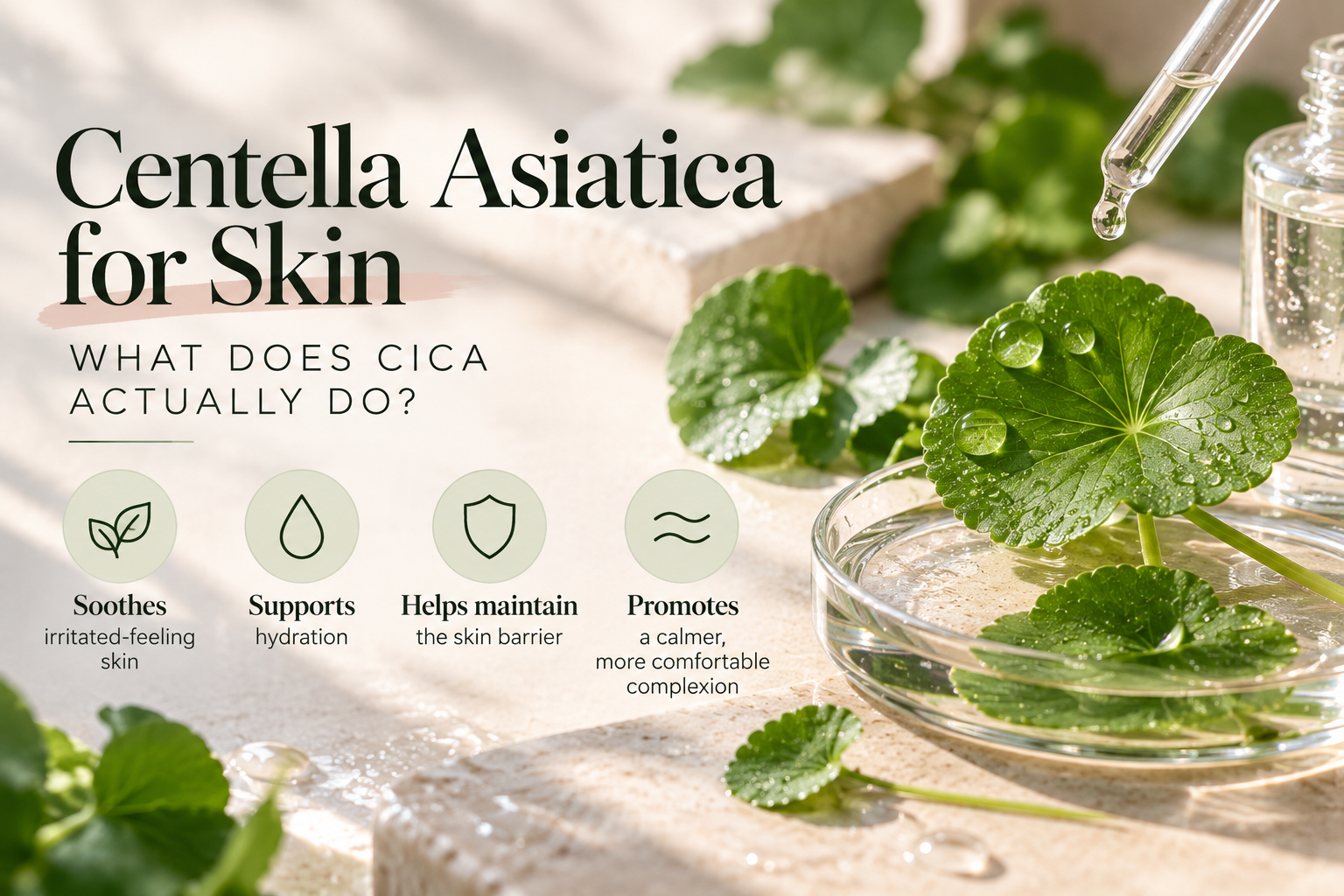
Centella Asiatica for Skin: What Does Cica Actually Do?
Centella asiatica for skin has become especially popular in Korean skincare, appearing in everything from toners and serums to creams and masks.
You may also know it as cica.
And the claims can be impressive: calming redness, repairing the skin barrier, increasing hydration, healing acne and even stimulating collagen.
So, what can Centella asiatica for skin realistically do?
There is real research behind this plant and several of its active compounds. However, much of the strongest evidence comes from wound-healing research or specific Centella preparations—not necessarily the everyday cica serum sitting on your bathroom shelf.
That distinction matters.
What Is Centella Asiatica?
Centella asiatica is a plant traditionally used in several Asian medical systems.
In skincare, you will often see it called cica.
Centella contains several biologically active triterpenes, including:
- asiaticoside
- madecassoside
- asiatic acid
- madecassic acid
These compounds are responsible for much of the scientific interest surrounding Centella. Research has investigated their roles in processes involving inflammation, collagen synthesis and wound healing.
But seeing “Centella” on two ingredient lists does not necessarily mean those products contain the same thing.
One formula may use a whole plant extract. Another may contain madecassoside. Another may use a standardized extract with specific concentrations of several triterpenes.
That is one reason comparing Centella products based only on the percentage printed on the bottle can be misleading.
Is Cica the Same as Centella Asiatica?
In skincare marketing, cica generally refers to Centella asiatica or Centella-derived ingredients.
But cica is not one standardized cosmetic ingredient with one fixed composition.
A “cica cream” could contain Centella extract alongside many other moisturizing ingredients.
A different product might highlight madecassoside.
So when I see the word cica, I still check the actual ingredient list.
The front of the bottle tells you the marketing story.
The ingredient list tells you more about what is actually in the formula.
Centella Asiatica for Skin: What Are the Benefits?
The most interesting evidence around Centella involves wound healing, inflammation and skin recovery.
A 2022 systematic review examined four clinical trials involving Centella asiatica in human wound healing. The studies included different situations such as diabetic wounds, burns and skin recovering after laser treatment.
The results suggested potential benefits for outcomes including wound appearance, re-epithelialization and healing.
However, only four studies met the review criteria, and the researchers specifically noted that more studies were needed.
A 2024 review also summarized research on topical Centella and its major compounds, including asiaticoside and madecassoside, but much of this literature again relates to wound care and specialized formulations rather than ordinary cosmetic serums.
So I would not translate this into:
“My cica serum heals damaged skin.”
A more accurate conclusion is that Centella contains biologically interesting compounds with evidence related to skin recovery, while the results of a specific cosmetic product depend heavily on its formulation.
Does Centella Help Calm Redness?
This is probably one of the reasons cica products became so popular.
Research suggests that Centella and some of its compounds have anti-inflammatory activity. Clinical and experimental studies have investigated effects on erythema and inflammatory pathways.
But “redness” is not one single skin problem.
Your face can look red because of irritation, over-exfoliation, acne, rosacea, sun exposure, dermatitis or many other reasons.
So I would be careful with claims that Centella simply “treats redness.”
A Centella-containing product may be useful in a gentle, soothing routine, but persistent or unexplained redness deserves proper evaluation rather than endless experimentation with calming serums.
Does Centella Support the Skin Barrier?
There is some human research supporting this idea.
One study involving 25 volunteers tested cosmetic formulations containing 2.5% and 5% Centella asiatica extract over four weeks. The 5% formulations improved measured skin hydration and reduced transepidermal water loss, or TEWL, under the study conditions.
That’s interesting because TEWL is one measurement related to how effectively the outer skin limits water loss.
But this does not mean:
5% Centella is the perfect concentration.
It was one specific study using particular formulations.
The overall moisturizer base and other ingredients matter too.
If your skin currently feels tight, unusually sensitive or easily irritated, my guide to Damaged Skin Barrier? Signs, Causes and How to Repair It explains the basic routine I would prioritize before chasing individual ingredients.
Centella vs Madecassoside: What’s the Difference?
This can get confusing quickly.
Centella asiatica is the plant.
Madecassoside is one of the major triterpenoid compounds associated with Centella.
Other important Centella compounds include asiaticoside, asiatic acid and madecassic acid.
So a product containing madecassoside is using a Centella-derived component rather than necessarily relying on a general whole-plant extract.
Neither is automatically better.
A standardized extract with known active compounds may be easier to characterize scientifically, while a cosmetic product containing whole Centella extract can still be a perfectly reasonable formulation.
Again, the finished formula matters more than whichever ingredient name sounds more impressive.
What Percentage of Centella Should You Use?
I would not chase a Centella percentage.
You may see Korean skincare products advertising extremely high percentages of Centella extract.
That number can look impressive, but 90% Centella extract does not automatically mean nine times more effective than 10%.
Different extracts can vary in concentration, extraction method and composition.
And the clinical literature uses very different preparations.
For example, the cosmetic study I mentioned evaluated 2.5% and 5% extracts, while wound-healing research has used completely different standardized preparations and delivery systems.
There is currently no universal evidence-based percentage that I would call the ideal Centella concentration for everyday skincare.
Is Centella Good for Sensitive Skin?
This is another claim I would phrase carefully.
Centella is commonly included in products designed for sensitive or easily irritated skin, and its anti-inflammatory properties make that positioning understandable.
But Centella itself does not make an entire formula suitable for sensitive skin.
A cica serum could still contain fragrance, essential oils or other ingredients that your skin dislikes.
And even botanical extracts themselves can occasionally trigger reactions.
If your skin is sensitive, I would judge the complete formulation rather than assuming anything labeled “cica” is automatically gentle.
Centella vs Hyaluronic Acid
These ingredients are often found together, but they are not doing exactly the same job.
Hyaluronic acid is primarily used as a humectant to support skin hydration.
Centella is a botanical ingredient whose compounds have been investigated for skin recovery, inflammatory pathways and barrier-related effects.
If dehydration is your main concern, HA may be the more straightforward ingredient.
If you want a soothing formula that also contains ingredients associated with skin recovery and barrier support, Centella may be interesting.
You also do not need to choose between them.
Many products contain both.
I explain HA in more detail in Hyaluronic Acid for Skin: Benefits, How to Use It & What to Know.
Centella vs Ectoin
These two ingredients are increasingly appearing in barrier-focused skincare, but they come from very different places.
Centella is a botanical extract with several active triterpenes.
Ectoin is an extremolyte produced by microorganisms that survive stressful environmental conditions.
Both are being studied in relation to hydration, skin comfort and barrier function, but their research histories and mechanisms are different.
I would not rank one as universally better.
More importantly, I would not buy both simply because they are trending.
If your moisturizer already keeps your skin comfortable, adding another soothing serum may not change much.
How to Use Centella in a Skincare Routine
Centella is relatively easy to incorporate because it is found in many different product types.
A simple routine might look like:
Morning
Gentle cleanse → Centella serum or toner if needed → Moisturizer → Sunscreen
Evening
Cleanse → Centella product → Moisturizer
If your moisturizer already contains Centella, you do not need a separate Centella toner, ampoule and serum.
That is something I pay attention to in my own routine.
I generally prefer one main serum or ampoule before moisturizer rather than stacking several products just because each contains a different trending ingredient.
If you are unsure where an ampoule or serum belongs, see How to Layer Skincare Products: The Right Order for Morning and Night.
Can You Use Centella With Retinol or Vitamin C?
Generally, Centella does not need to be separated from common skincare actives in the way people sometimes worry about acids or retinoids.
Depending on the formulation, it can fit into routines containing:
- retinol
- vitamin C
- niacinamide
- hyaluronic acid
- azelaic acid
In fact, a simple moisturizing Centella product may be useful when your routine contains an active that your skin finds drying.
But compatibility does not mean you need everything at once.
I would rather introduce new products individually and understand how my skin responds than build a six-serum routine where I cannot tell what is helping—or irritating—my skin.
Is Centella Worth the Hype?
For me, Centella sits in an interesting category.
It is not simply a meaningless K-beauty marketing ingredient.
There is legitimate research behind Centella asiatica and its active compounds, particularly around wound healing and inflammatory processes. Human cosmetic research also suggests potential hydration and barrier-related benefits.
But skincare marketing often takes that research several steps further than the evidence allows.
A wound-healing study does not prove that every cica toner “repairs” your face.
A high Centella percentage does not automatically make a product better.
And “cica” on the front of a bottle does not guarantee that the rest of the formula will suit sensitive skin.
The Bottom Line
Centella asiatica deserves its place in modern skincare—especially within the soothing and barrier-focused side of K-beauty.
Its compounds, including madecassoside and asiaticoside, have genuine biological activity and an established research history. But the evidence is much stronger for certain preparations and clinical contexts than for every cosmetic product marketed as cica.
I would think of Centella as a potentially useful supporting ingredient, particularly when you want a gentle routine focused on hydration, comfort and barrier support.
Not a miracle ingredient.
Not a replacement for moisturizer.
And definitely not something you need in five different steps of the same routine.
For me, that is actually what makes Centella appealing: it does not need to do everything to have a useful place in skincare.