Cleansing Oil vs Balm vs Milk: Which One Should You Use?
If you’re choosing a first cleanser, comparing cleansing oil vs balm vs milk can get confusing quickly.
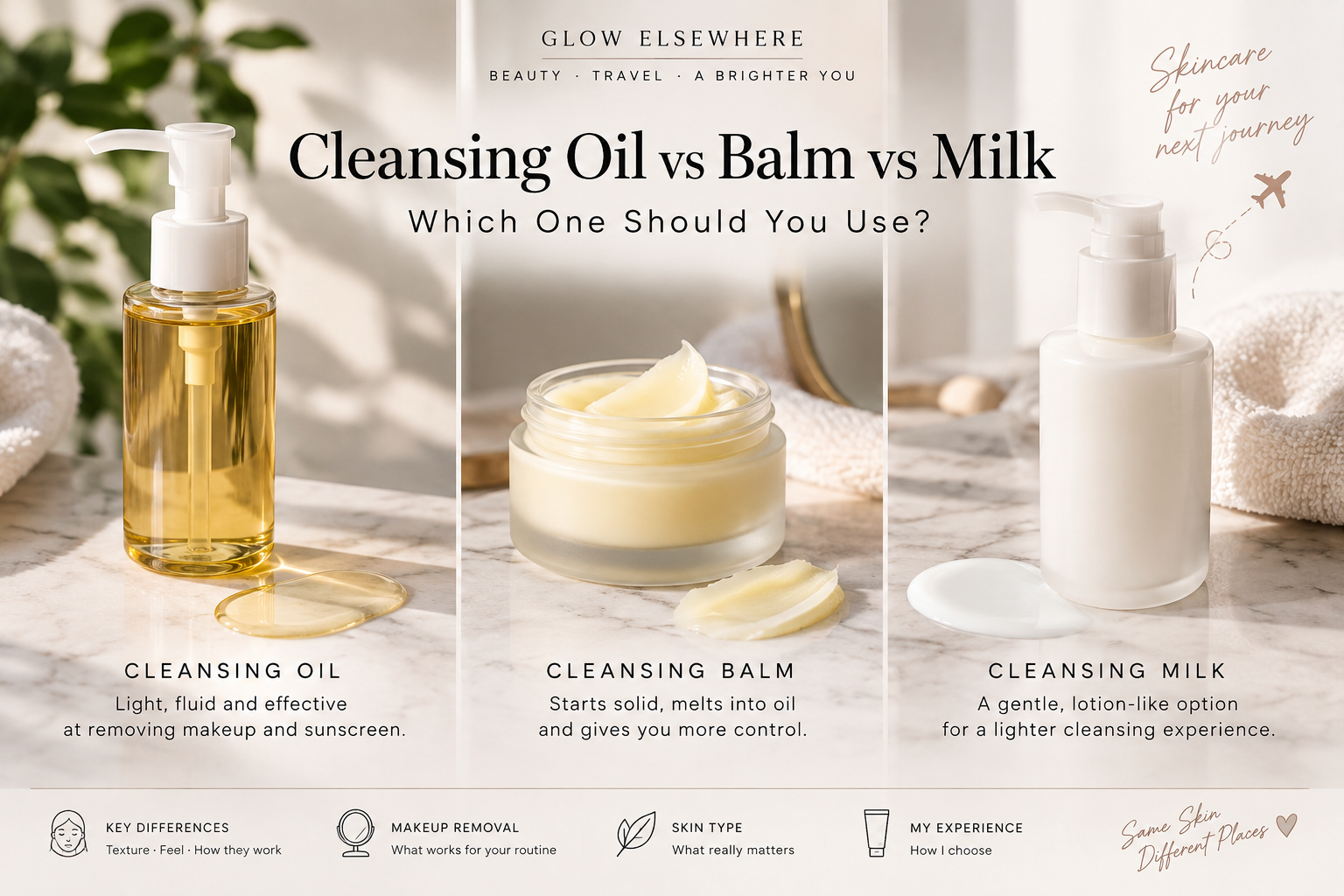
All three can help remove makeup, sunscreen and buildup, but they feel very different on the skin. Cleansing oil starts fluid, balm begins solid and melts as you massage it, while cleansing milk usually has a lighter, lotion-like texture.
I’ve used all three in my own routine, and I don’t think there’s one universal winner.
The better question is: what are you trying to remove, and which texture works best for your routine?
Cleansing Oil vs Balm vs Milk: The Quick Difference
Cleansing oil is fluid from the beginning. It spreads easily over dry skin and is commonly used as a first cleanser for makeup and sunscreen.
Cleansing balm starts solid or semi-solid and melts into an oil-like texture as you massage it. Because it doesn’t run between your fingers, some people find it easier to control.
Cleansing milk usually feels more like a lightweight lotion or emulsion. It may appeal to people who don’t enjoy the richer sensation of oils or balms.
These are mainly differences in texture and cleansing experience—not strict rules about which skin type should use each one.
The individual formula matters too.
What Is a Cleansing Oil?
Cleansing oils are designed to help loosen makeup, sunscreen and oily buildup from the skin.
I normally apply cleansing oil to a dry face with dry hands and massage it gently. Then I add water. Many cleansing oils turn milky as they emulsify before rinsing away.
What I like most about oil is the slip.
After wearing makeup for a long time, I don’t want to rub aggressively to remove it. A fluid oil spreads quickly and makes the process easy.
That doesn’t mean cleansing oil is automatically better than balm or milk. It’s simply a texture I find convenient.
What Is a Cleansing Balm?
A cleansing balm serves a similar purpose but starts with a thicker texture.
You scoop out a small amount and massage it over dry skin. As you massage, it gradually melts into an oil-like consistency before being emulsified and rinsed according to the product directions.
For me, the biggest difference between balm and oil is often the experience of using them.
Oil starts liquid.
Balm gives you more control at first and then melts.
If you enjoy a richer, melting texture, you may prefer a balm.
What Is Cleansing Milk?
Cleansing milk usually has a softer, lotion-like texture and can feel lighter than an oil or balm.
I’ve used cleansing milk alongside oils and balms, and I enjoy the lighter cleansing experience.
But I wouldn’t automatically say:
“Cleansing milk is for sensitive skin.”
Just as I wouldn’t say oil belongs to oily skin or balm belongs to dry skin.
Skin type can influence what feels comfortable, but the complete formula and how your own skin responds matter more than the category name.
Which One Removes Makeup Best?
There’s no simple winner because makeup removal depends on both the cleanser and what you’re trying to remove.
Removing light sunscreen and minimal makeup isn’t necessarily the same job as removing long-wear foundation or heavier makeup after a long day.
Cleansing oils and balms are commonly used as first cleansers for makeup and sunscreen. Cleansing milk can also work well depending on its formula and the products you’re trying to remove.
Instead of asking which category is strongest, I would ask:
- Does it remove my makeup without excessive rubbing?
- Does it rinse away comfortably?
- Does my skin feel comfortable afterward?
- Do I actually enjoy using it?
Those questions are more useful than assuming every oil is stronger than every milk or every balm is gentler than every oil.
Does Your Skin Type Matter?
Yes, but I wouldn’t use skin type as a rigid rule.
You may see advice that simplifies the choice into:
Oily skin = cleansing oil
Dry skin = cleansing balm
Sensitive skin = cleansing milk
Real skincare isn’t that simple.
Having oily skin doesn’t automatically mean you need—or should avoid—an oil cleanser. A rich balm isn’t automatically the best option for dry skin, and the word “milk” doesn’t guarantee that a cleanser will suit sensitive skin.
The overall formulation varies from product to product.
If your skin is easily irritated or prone to breakouts, pay attention to how your skin responds to the specific cleanser rather than choosing entirely by category.
Do You Need to Double Cleanse?
Not everyone needs to double cleanse every night.
I personally do when I’ve been wearing makeup for work.
After a long makeup day, my routine is usually:
Cleansing oil, balm or milk → rinse → gentle second cleanser → skincare
For my second cleanse, I prefer a gentle, mildly acidic cleanser.
The goal isn’t to make my face feel squeaky clean. I simply want to remove makeup and buildup first, then start my nighttime skincare on clean skin.
If you’re interested in the full routine, I explain it in Skincare After Makeup: How to Cleanse Without Overdoing It.
How I Choose Between Oil, Balm and Milk
My own method is actually very simple:
I don’t have a strict system.
I’ve used all three and rotate between them depending on what I have and what I feel like using.
The textures are noticeably different, but in my own routine I haven’t found the differences dramatic enough to create rigid rules around them.
What matters much more to me is properly removing my makeup.
There was a time when my cleansing wasn’t as consistent as it is now. As I became more consistent with skincare, I started paying attention not only to what I put onto my skin, but also to what I properly remove first.
That’s why cleansing has become one of the basic parts of my routine that I rarely skip.
So Which One Should You Choose?
Keep it simple.
Choose cleansing oil if you like a fluid texture that spreads quickly.
Choose cleansing balm if you prefer a solid product that melts as you massage it.
Try cleansing milk if you prefer a lighter, lotion-like cleansing experience.
But don’t treat these as rules.
You don’t need to own all three either.
Start with one formula that fits your makeup habits, skin comfort and texture preference. If it removes what you need without excessive rubbing and your skin feels comfortable afterward, you may already have what you need.
The Bottom Line
When comparing cleansing oil vs balm vs milk, the biggest difference is usually texture and cleansing experience—not a universal ranking from best to worst.
I’ve used all three, and I still rotate between them.
For me, choosing a first cleanser isn’t about finding the category that everyone says is “best.”
It’s about finding something that makes it easy to properly take my makeup off at the end of the day.