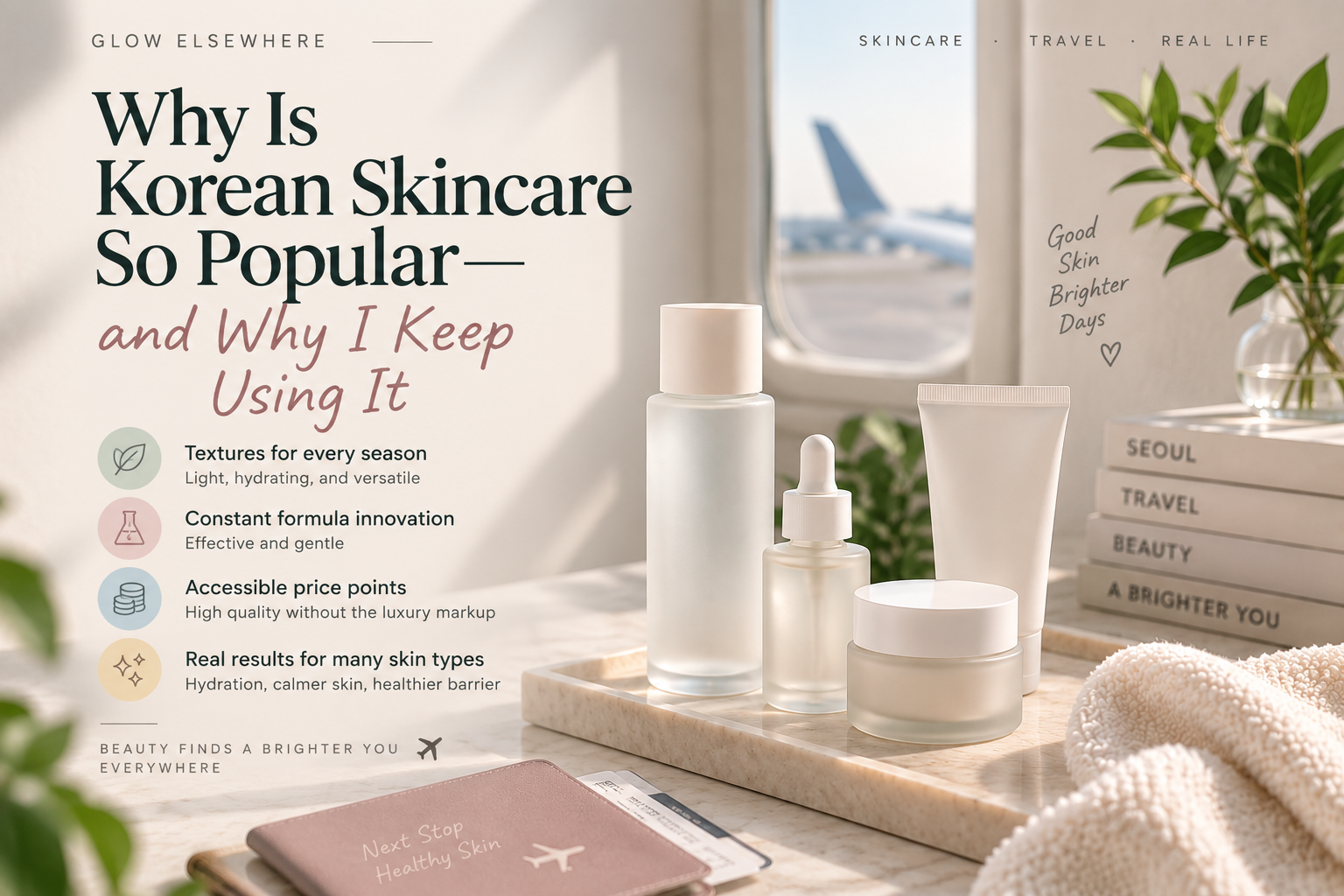
Why Is Korean Skincare So Popular—and Why I Keep Using It
If you’ve spent any time looking at skincare online, you’ve probably wondered why Korean skincare is so popular.
Korean sunscreens, cleansing oils, toners, essences, ampoules, sheet masks and moisturizers are now easy to find far beyond Korea.
And this isn’t just an online trend.
According to South Korea’s Ministry of Food and Drug Safety, Korean cosmetics exports reached a record $11.4 billion in 2025, up 11.8% from the previous year. South Korea also became the world’s second-largest cosmetics exporter by export value that year.
But popularity doesn’t automatically mean every Korean skincare product is better.
I’m Korean, and Korean products make up a large part of my own routine. But I don’t choose something simply because it says “Made in Korea.”
So what actually made Korean skincare so popular—and why do I personally keep coming back to it?
Korean Skincare Isn’t Just the 10-Step Routine
One of the first things many people outside Korea associate with K-beauty is the famous 10-step Korean skincare routine.
Double cleanse. Toner. Essence. Serum. Ampoule. Sheet mask. Eye cream. Moisturizer.
And so on.
But you absolutely don’t need ten steps to use Korean skincare.
The philosophy behind a routine matters much more than following a fixed number of steps. Introducing too many products at once can also make it harder to know what is helping your skin—or what might be causing a reaction.
That’s much closer to how I approach skincare now.
Some days my routine is very simple.
Other days I add something because my skin actually needs it.
The number of steps isn’t the point.
1. There Are So Many Textures to Choose From
One thing I genuinely appreciate about Korean skincare is how much choice I have depending on what my skin needs at that moment.
Walk into a Korean beauty store and you’ll find watery toners, milky toners, lightweight serums, ampoules, gels, emulsions, lotions, rich creams and countless variations in between.
For me, that variety is one of the biggest advantages.
In summer, I might want a lightweight cream that feels comfortable without being heavy. In winter, or whenever my skin feels particularly dry, I can switch to something much richer and more moisturizing.
The same applies when my skin feels oily, dehydrated or irritated, or when I need products that sit comfortably underneath makeup.
I don’t have to change the basic idea of my routine. I can change the texture and level of moisture according to what my skin needs.
This became particularly important to me because my own skin can become oily while still feeling dehydrated.
I’ve also learned from years of wearing makeup for work that a product can be perfectly fine on its own but less suitable for me underneath makeup.
I also like how quickly the Korean beauty market continues to develop new formulas, textures and product options.
That doesn’t mean every new launch is innovative, better or something I need. I still look at whether a product actually makes sense for my skin before buying it.
But having so many options means I can usually compare several different products designed for a similar skincare need.
And because many Korean skincare products are available at relatively accessible price points, trying a different texture or formula doesn’t always feel like a major investment.
That combination—variety, adaptability and accessible pricing—is one of the biggest reasons I continue to use Korean skincare.
2. Hydration Has a Big Place in K-Beauty
Another reason K-beauty feels distinctive is the amount of attention given to hydration.
That doesn’t mean every Korean product is hydrating or that hydration solves every skin problem.
But toners, essences, ampoules, serums and moisturizers give people many ways to add hydration without necessarily relying on one very heavy product.
This is one part of K-beauty that fits my own experience particularly well.
Early in my cabin-crew career, I was focused on oil.
My forehead could become shiny, so I assumed that reducing moisture was the obvious answer.
But after spending more time in dry aircraft cabins and paying closer attention to my skin, I realized that oiliness and dehydration weren’t necessarily the same problem.
That changed the way I chose products.
Instead of asking only:
“Will this make me less oily?”
I started asking:
“Will this keep my skin comfortable without feeling too heavy?”
That was a much more useful question for me.
If oily skin can still feel tight or dehydrated, I explain that distinction in more detail in Oily but Dehydrated Skin: Why Your Face Feels Greasy and Tight.
3. Skincare Is Treated as Everyday Maintenance
Another part of Korean skincare that resonates with me is the idea of skincare as regular maintenance rather than emergency repair.
There will always be products promising dramatic results.
K-beauty isn’t immune to marketing.
But skincare in Korea is also a very ordinary part of everyday personal care.
For me, this translates into something simple:
I don’t want to wait until my skin feels terrible before paying attention to it.
It’s similar to the way I think about my skin before a long flight.
I used to focus much more on what I could do once my skin already felt dry.
Now I care more about the routine I’ve maintained before I even step onto the aircraft.
Good skin days, for me, are usually built through boring consistency rather than one dramatic rescue product.
4. Korean Skincare Offers More Than One Way to Do the Same Job
K-beauty has also made certain product categories much more visible internationally.
Essences and ampoules are obvious examples.
So are cleansing balms, cleansing oils, sheet masks and lightweight sunscreen formats.
That doesn’t mean you need all of them.
It means you have options.
Take cleansing.
Depending on what I have at home, I rotate between cleansing milk, cleansing oil and cleansing balm as my first cleanse.
I don’t have a strict rule that one is always better than the others.
They simply give me different ways to perform the same basic job: removing makeup and sunscreen before my second cleanse.
That ability to choose based on texture, preference and routine is one of the things I like about Korean skincare.
5. Accessible Prices Make Choice More Practical
Another part of K-beauty’s appeal is that there are products across a wide range of prices.
Of course, Korean skincare isn’t automatically inexpensive. There are plenty of premium products and brands.
But many cleansers, toners, serums, ampoules, moisturizers and sunscreens are available at price points that make comparing different options more realistic.
For me, this works together with the variety I mentioned earlier.
If I want something lighter for summer or richer for winter, there are usually multiple formulas and price points to consider.
But affordability doesn’t automatically equal value.
A product that sits unused in my bathroom is still wasted money, no matter how inexpensive it was.
And that’s one of the biggest changes in how I personally shop for skincare now.
How I Choose Korean Skincare Now
These days, I’m less interested in what’s viral and more interested in what my skin actually needs.
Before trying a product, I think about its purpose, texture, how it fits into my existing routine and whether it contains ingredients my skin already tolerates.
Most importantly, I ask myself whether I actually need it—or whether I simply want it because I’ve seen it everywhere.
It sounds simple, but this change has helped me build a much more consistent routine and avoid buying products I probably wouldn’t use.
That’s also why my routine isn’t exclusively Korean.
I use a lot of Korean skincare because I often like the combination of quality, formulas, textures, variety and price.
But if a non-Korean product works well for me, I’m not going to replace it just to make my shelf 100% K-beauty.
Country of origin isn’t a skin type.
Does Korean Skincare Mean You Need More Products?
No.
And this is probably one of the most important misconceptions I’d like to avoid on Glow Elsewhere.
Having access to more product categories doesn’t mean you need to use all of them.
A toner can be useful without being mandatory.
An essence can be enjoyable without being essential.
A serum or ampoule can target a particular need without becoming a permanent step in every person’s routine.
A sheet mask can be something you enjoy occasionally rather than something your skin requires every night.
This fits directly with how I build my own routine now.
In How to Build a Simple Skincare Routine That Actually Works, I explain why I prefer starting with the basics and adding products only when they have a clear purpose.
K-beauty doesn’t change that principle.
If anything, having so many options makes that principle even more important.
Is Korean Skincare Better Than Western Skincare?
I wouldn’t make that claim.
“Korean skincare” and “Western skincare” are enormous categories containing thousands of products, formulas and brands.
A great Korean product can work beautifully for one person and irritate another.
The same is true of products made anywhere else.
There are also skin concerns that shouldn’t be treated by endlessly buying cosmetic products.
Persistent acne, dermatitis, painful irritation, significant rashes or other ongoing skin problems may require professional medical care.
Korean skincare isn’t medicine simply because it’s popular.
And no skincare product becomes automatically effective because it comes from Korea.
So Why Do I Keep Using Korean Skincare?
For me, it’s the combination.
I like having many textures to choose from.
I can choose something lighter when my skin needs less and something richer when it needs more.
I like being able to find hydration that doesn’t automatically feel heavy.
I like the variety of cleansers, serums, ampoules and moisturizers available.
I like seeing new textures and formulas continue to appear, while still being able to choose simple products that fit easily into my existing routine.
And price matters too.
After almost five years of flying, dealing with dry cabin environments, irregular schedules and long makeup days, I’ve become much more selective about what earns a place in my routine.
I don’t need the newest product.
I need something that works with my skin and with the life I’m actually living.
A lot of Korean skincare happens to fit that requirement for me.
That’s why I keep using it.
Not simply because it’s Korean.
But because I’ve found Korean products that work well for my skin, my routine and my lifestyle.
The Bottom Line
So, why is Korean skincare so popular?
There isn’t one reason.
Its global growth has been supported by a combination of product variety, different textures and formats, accessible price points, a strong emphasis on hydration and consistent skincare, and an industry that now reaches consumers far beyond Korea.
But popularity shouldn’t decide your routine.
You don’t need ten steps.
You don’t need every trending ingredient.
And you certainly don’t need to replace products that already work just because something new is going viral.
The part of Korean skincare I value most isn’t having more products.
It’s having more choices—and learning which ones are actually worth choosing.