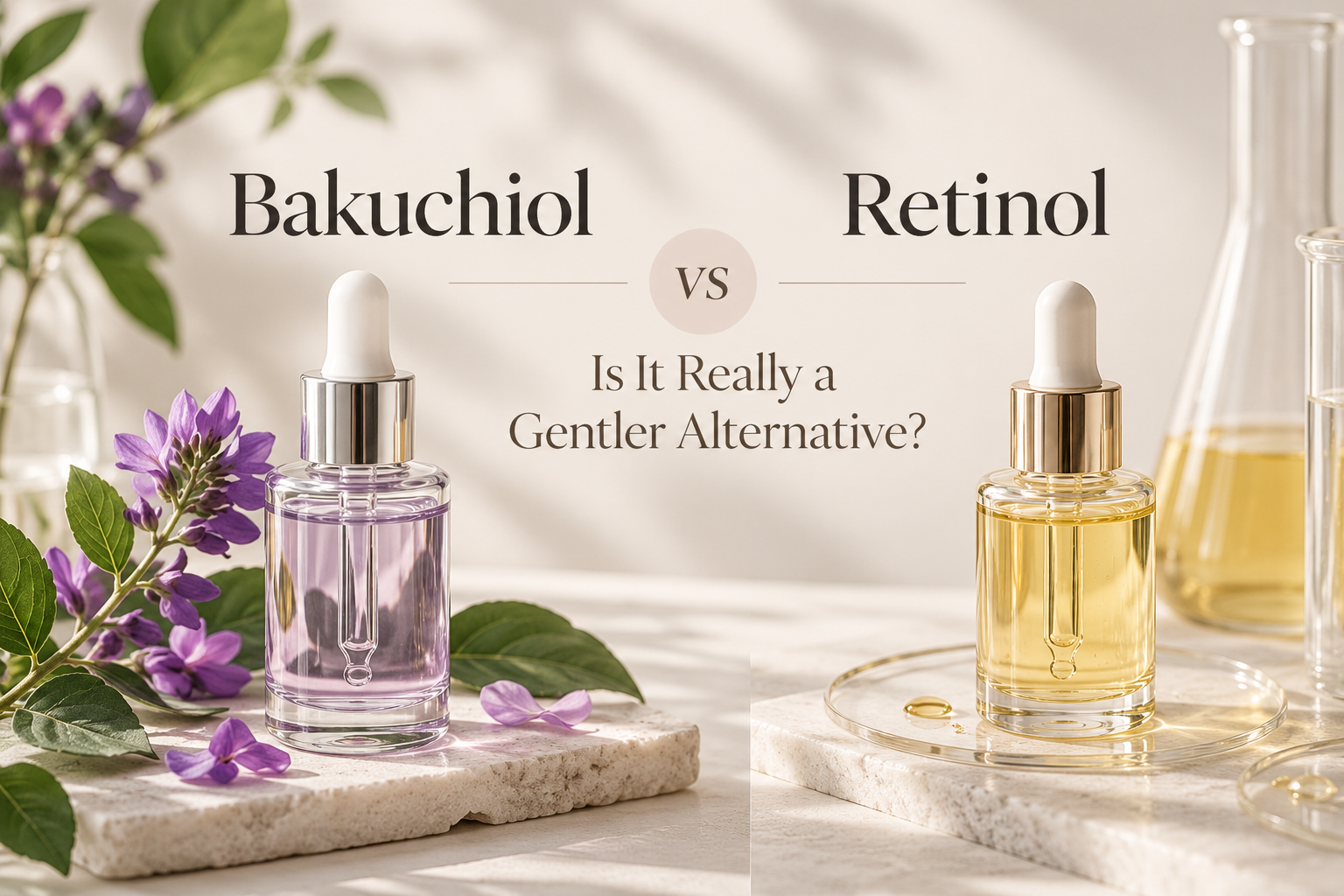
Bakuchiol vs Retinol: Is It Really a Gentler Alternative?
Bakuchiol vs retinol has become a popular comparison for anyone interested in smoother-looking skin, pigmentation and signs of photoaging—but worried about the irritation that can come with retinoids.
Bakuchiol is often marketed as “natural retinol” or a gentler plant-based replacement.
That sounds simple.
The evidence is more interesting.
Bakuchiol does have human clinical research behind it, including a study directly comparing it with retinol. But bakuchiol is not a retinoid, and the research supporting it is much smaller than the evidence base behind retinoids.
So rather than asking whether bakuchiol is simply “better” or “worse” than retinol, it makes more sense to understand what each ingredient actually does.
What Is Bakuchiol?
Bakuchiol is a plant-derived compound associated with Psoralea corylifolia, also known as babchi.
Chemically, it is not retinol and does not belong to the retinoid family.
However, laboratory research has found that bakuchiol can influence some skin pathways and gene-expression patterns that overlap with those affected by retinol. This is one reason it began attracting attention as a possible retinol alternative.
But similar effects in certain pathways do not make two ingredients identical.
That distinction matters.
Bakuchiol vs Retinol: What Does the Research Say?
One study is responsible for a lot of the excitement around bakuchiol.
In a randomized, double-blind 12-week trial, 44 participants used either:
0.5% bakuchiol twice daily
or
0.5% retinol once daily.
Both groups showed significant reductions in measured wrinkle surface area and hyperpigmentation, and researchers found no statistically significant difference between the two groups for those outcomes.
The retinol group, however, reported more scaling and stinging.
That makes bakuchiol genuinely interesting.
But it does not prove that bakuchiol and retinol are equivalent ingredients.
This was one relatively small study, and the products were used at different frequencies.
A 2024 systematic review examined 15 human clinical trials involving topical bakuchiol formulations. Researchers found potentially useful results for concerns including photoaging, acne and post-inflammatory hyperpigmentation.
However, they also found major limitations.
Twelve of the studies were unblinded open-label trials without a control group. Ten used combination formulas rather than bakuchiol alone, and several did not clearly report the bakuchiol concentration.
The reviewers concluded that the evidence had a high risk of bias and needed more rigorous trials.
So my interpretation is:
Bakuchiol is promising. Retinol has the much deeper evidence base.
Is Bakuchiol Really a Gentler Retinol Alternative?
Possibly—and this is one of the more convincing reasons to be interested in it.
In the direct comparison study, participants using retinol reported more scaling and stinging than those using bakuchiol.
That suggests bakuchiol may be worth considering for someone who wants to explore photoaging or pigmentation care but finds retinol difficult to tolerate.
But I would still avoid calling bakuchiol “retinol without irritation.”
Any cosmetic ingredient can potentially cause irritation or an allergic reaction, and cases of contact dermatitis associated with bakuchiol have been reported.
The finished formula matters too.
A bakuchiol serum containing fragrance or other active ingredients may behave very differently from a simple bakuchiol formula used in a clinical trial.
Bakuchiol vs Retinol for Wrinkles
When comparing bakuchiol vs retinol for wrinkles, the biggest difference is the strength of the evidence behind them. Retinoids have decades of research behind their use for photoaged skin, while bakuchiol’s evidence is much newer and smaller.
The direct clinical trial is encouraging because both groups showed improvement in wrinkle surface area after 12 weeks. But one small trial cannot establish that bakuchiol will consistently perform as well as retinol across different concentrations, formulations and populations.
So if the question is:
“Does bakuchiol have evidence for improving the appearance of photoaged skin?”
Yes, there is some human evidence.
If the question is:
“Has bakuchiol been proven to work exactly as well as retinol?”
The current evidence is not strong enough for me to make that claim.
What About Dark Spots and Post-Acne Marks?
Bakuchiol has also been investigated for pigmentation.
In the same 12-week comparison study, both bakuchiol and retinol groups showed improvement in hyperpigmentation. Other clinical studies reviewed in the literature have investigated bakuchiol-containing products for post-inflammatory hyperpigmentation as well.
Again, there is an important limitation.
Many studies used combination products, so we cannot automatically credit every improvement to bakuchiol alone.
And if pigmentation is your main concern, bakuchiol is not the only option.
Ingredients such as azelaic acid, tranexamic acid, vitamin C and niacinamide all have different evidence and roles in pigmentation-focused routines.
What Percentage of Bakuchiol Should You Use?
You will often see 0.5% bakuchiol mentioned online.
There is a legitimate reason: the best-known direct retinol comparison used 0.5% bakuchiol.
But that does not establish 0.5% as the universal ideal concentration.
The 2024 systematic review found that several human trials did not even clearly state the bakuchiol concentration, while many tested multi-ingredient formulas.
So I would not choose a product based on percentage alone.
The concentration, vehicle, supporting ingredients, stability and overall formulation all matter.
Higher is not automatically better.
How to Use Bakuchiol
Bakuchiol is generally easier to fit into a routine than a traditional retinoid.
A simple routine could look like:
Morning
Gentle cleanse → Bakuchiol product → Moisturizer → Sunscreen
Evening
Cleanse → Bakuchiol product → Moisturizer
You do not necessarily need to use it twice daily just because one clinical trial did.
Follow the directions of the particular product and introduce it gradually if your skin is sensitive.
And although bakuchiol is often discussed as being easier to use during the day than retinol, it does not replace sunscreen.
Daily sun protection remains important, especially if pigmentation and photoaging are the concerns you are trying to address.
Can You Use Bakuchiol With Other Actives?
Bakuchiol does not need the same complicated reputation for ingredient conflicts that retinoids sometimes receive.
Depending on the finished formulations and your skin tolerance, it may fit into routines containing ingredients such as:
- niacinamide
- hyaluronic acid
- vitamin C
- azelaic acid
But that does not mean you need all of them at once.
I prefer keeping skincare relatively simple and choosing products according to what my skin actually needs rather than stacking several active serums simply because they are compatible.
If you’re unsure about the order, my guide to How to Layer Skincare Products explains how I keep morning and evening routines simple.
Should You Use Bakuchiol and Retinol Together?
This is where I would ask a different question:
Why are you adding both?
Some cosmetic formulas combine bakuchiol with retinol, and there is research interest in using the ingredients together.
But if you are choosing bakuchiol specifically because your skin does not tolerate retinol well, immediately adding retinol back into the routine defeats much of that purpose.
If you already tolerate retinol well, you also do not automatically need bakuchiol on top of it.
More active ingredients do not automatically produce better skin.
For anyone new to retinol, I explain the basics separately in Retinol for Beginners: How to Start Without Overdoing It.
Is Bakuchiol Safe During Pregnancy?
This claim deserves particular caution.
Bakuchiol is frequently marketed online as a pregnancy-safe alternative to retinol.
Retinoids are generally avoided during pregnancy, so it is understandable why this comparison attracts attention.
But that does not automatically prove that bakuchiol is safe during pregnancy.
A review of topical bakuchiol noted that clinical studies specifically involving pregnant or breastfeeding participants have not been performed, meaning there is not enough direct human pregnancy evidence to make a definitive safety claim.
So I would not label a bakuchiol product “pregnancy safe” based solely on the fact that it is not a retinoid.
If you are pregnant, breastfeeding or trying to conceive, discuss active skincare ingredients with your healthcare professional.
Who Might Prefer Bakuchiol?
In a bakuchiol vs retinol comparison, skin tolerance may be one of the most practical factors to consider.
Bakuchiol may be particularly interesting if:
- you want to address visible photoaging or uneven tone
- retinol has been difficult for your skin to tolerate
- you want to explore a non-retinoid option
- you prefer a simpler active routine
Retinol may make more sense if you tolerate it well and want an ingredient backed by a much larger body of research.
Neither choice has to be permanent.
Skincare is not a competition between ingredients.
The better option is the one that addresses your concern, works within your routine and that your skin can actually tolerate consistently.
What I Would Look for in a Bakuchiol Product
I would not buy something simply because the label says “natural retinol.”
Instead, I would check:
Is the bakuchiol concentration disclosed?
Is the rest of the formula appropriate for my skin?
Are there other active ingredients that could change its tolerability?
Are the brand’s claims based on the finished product or borrowed from unrelated bakuchiol research?
And most importantly:
Am I choosing bakuchiol because it solves a problem in my routine—or because it is trending?
That last question has saved me from buying a lot of unnecessary skincare.
The Bottom Line
Bakuchiol deserves more credit than being dismissed as another viral skincare ingredient.
There is human clinical evidence suggesting that topical bakuchiol can improve signs of photoaging and pigmentation, and one randomized trial found comparable improvements to retinol with less reported scaling and stinging.
But the overall evidence base remains limited.
A systematic review of human trials found substantial methodological weaknesses, including uncontrolled studies and frequent use of combination formulations.
So I would not call bakuchiol “natural retinol,” “better than retinol,” or “retinol with no side effects.”
A more accurate description is:
Bakuchiol is a different ingredient with promising retinol-like skincare effects and potentially better tolerability, but it does not yet have the depth of evidence behind retinoids.
And for someone whose skin simply does not get along with retinol, that difference may be exactly what makes bakuchiol worth knowing about.