Azelaic Acid for Skin: Benefits, How to Use It & What to Know
Azelaic acid for skin has become increasingly popular, especially for people dealing with breakouts, post-acne marks, uneven-looking skin tone or redness.
But unlike some trending ingredients, azelaic acid isn’t new.
It has been used in dermatology for years, particularly for acne and rosacea, and research also supports its use for certain pigmentation concerns.
That combination makes azelaic acid interesting: it can address several common skin concerns without requiring an overly complicated routine.
So what exactly does azelaic acid do, what percentage should you choose, and where should it fit into your skincare routine?
What Is Azelaic Acid?
Azelaic acid is a dicarboxylic acid with antimicrobial, anti-inflammatory and pigmentation-related effects.
In dermatology, topical azelaic acid has been studied particularly for acne, rosacea and hyperpigmentation. A systematic review of 43 randomized controlled trials found evidence supporting its effectiveness for acne and rosacea, as well as melasma.
That doesn’t mean one azelaic acid product will solve every skin concern.
The concentration, formulation, frequency of use and the condition you’re trying to address all matter.
Azelaic Acid for Skin: What Are the Benefits?
One reason azelaic acid attracts so much attention is that its potential benefits aren’t limited to one concern.
1. It Can Help With Acne
Azelaic acid can help with both inflammatory and non-inflammatory acne.
Its effects include antimicrobial and anti-inflammatory activity as well as effects on abnormal keratinization, which can contribute to clogged pores.
That makes it particularly interesting for someone dealing with breakouts and the marks they can leave behind.
However, severe, painful, cystic or persistent acne is different. Those cases are worth discussing with a dermatologist rather than relying on one skincare ingredient.
2. It May Help With Post-Acne Dark Spots
Azelaic acid can also affect pathways involved in excess pigmentation.
This is why you’ll often see it discussed for post-inflammatory hyperpigmentation—the darker marks that can remain after a breakout.
A randomized controlled trial using 15% azelaic acid gel found improvement in post-acne erythema and hyperpigmentation over 12 weeks. That doesn’t mean every azelaic acid product will produce the same result, but it helps explain why the ingredient is frequently used when acne and post-acne marks occur together.
It’s better to think of azelaic acid as one useful option rather than an instant dark-spot eraser.
3. It Has a Role in Rosacea Treatment
Azelaic acid also has an established role in rosacea treatment.
The American Academy of Dermatology lists azelaic acid among topical treatments that can help with acne-like rosacea breakouts and notes that it may also help reduce long-lasting color.
However, persistent facial redness doesn’t automatically mean rosacea.
Acne, irritation and rosacea can sometimes look similar, so recurring or significant redness is a good reason to get a proper diagnosis rather than trying to diagnose it from skincare symptoms alone.
What Percentage of Azelaic Acid Should You Use?
One of the first questions people have about azelaic acid is whether they should choose 10%, 15% or 20%.
Here’s the simplest way to think about it.
If You’re New to Azelaic Acid
If you’re choosing an over-the-counter skincare product and are new to azelaic acid, a lower-strength formula such as 10% can be a practical place to start when that concentration is available in your market.
It lets you see how azelaic acid fits into your routine and how your skin tolerates the formula before considering whether you need something stronger.
However, 10% shouldn’t automatically be considered “better for beginners” in every situation.
The overall formulation matters too, and much of the stronger clinical evidence for treating conditions such as acne and rosacea comes from 15% and 20% formulations.
When Might 15% or 20% Make More Sense?
If you’re trying to treat persistent acne, rosacea or significant pigmentation rather than simply adding azelaic acid to a general skincare routine, it may be worth discussing a clinically studied 15% or 20% formulation with a dermatologist.
Both 15% and 20% formulations have been used in clinical research, and availability varies by country. Some higher-strength formulations may also be regulated as medications rather than ordinary cosmetic products.
So rather than thinking:
10% = weak
15% = medium
20% = best
Think about it this way:
New to azelaic acid or using it for general skincare:
A lower-strength cosmetic formula such as 10% can be a reasonable starting point if available.
Persistent acne, rosacea or pigmentation you’re specifically trying to treat:
Consider professional advice about clinically studied 15–20% formulations instead of simply buying the strongest percentage you can find.
Sensitive or easily irritated skin:
Don’t choose based on percentage alone. The formulation, frequency of use and your skin’s tolerance matter too.
Higher doesn’t automatically mean better. The vehicle matters as well—a gel and a cream can deliver the same ingredient differently.
The goal isn’t to use the highest percentage possible. It’s to find a formulation appropriate for the concern you’re addressing that your skin can tolerate consistently.
How to Use Azelaic Acid
Where azelaic acid fits depends partly on the product you’re using, so the manufacturer’s instructions should come first.
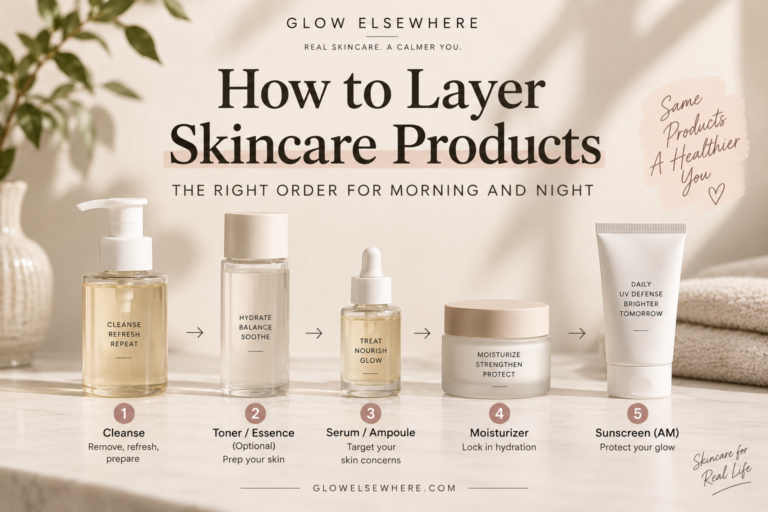
A simple routine might look like:
Morning:
Cleanser → Azelaic Acid → Moisturizer → Sunscreen
Evening:
Cleanser → Azelaic Acid → Moisturizer
Some formulations may work better at a different point in your routine, so don’t force every product into exactly the same rule.
If you’re unsure about the general order of skincare products, my guide to How to Layer Skincare Products explains where serums, treatments, moisturizer and sunscreen typically fit.
Should You Use Azelaic Acid in the Morning or at Night?
Azelaic acid can fit into either a morning or evening routine depending on the formulation, your other products and how your skin responds.
You don’t need to use an ingredient at every possible opportunity to make it worthwhile.
If you’re new to azelaic acid, introducing it gradually can make it easier to see how your skin responds before increasing frequency.
And if you’re using it in the morning, your routine should still finish with sunscreen.
Treating pigmentation while ignoring sun protection doesn’t make much sense, especially when discoloration is one of the concerns you’re trying to improve.
Can You Use Azelaic Acid With Vitamin C?
Azelaic acid and vitamin C don’t have to be treated as mutually exclusive ingredients.
Both may appear in routines targeting uneven-looking skin tone, but that doesn’t mean everyone needs to layer them together in the same routine.
If vitamin C is already part of your routine, you can also read my guide on How to Use Vitamin C Serum before deciding how to combine the two.
If your skin tolerates both ingredients, they may be used within the same overall skincare routine.
But if you’re introducing azelaic acid for the first time, I prefer a simpler approach: introduce one new active at a time.
For example, someone might keep vitamin C in the morning and introduce azelaic acid separately in the evening.
That’s not a universal requirement. It’s simply an easy way to avoid adding several variables at once.
Can You Use Azelaic Acid With Niacinamide?
Azelaic acid and niacinamide can also appear in the same skincare routine.
The bigger question is often not whether the two ingredient names can coexist, but whether the entire routine feels comfortable for your skin.
If layering multiple products causes persistent stinging, redness or dryness, simplifying the routine may be more useful than adding another ingredient.
What About Retinol?
This is where I would be more cautious about immediately layering everything together.
Retinoids and azelaic acid can both be used in acne-focused skincare, but each can potentially cause irritation depending on the formulation and individual skin.
If you’re new to either ingredient, there’s little reason to introduce both at the same time.
You could separate them between different routines or different nights while you learn what your skin tolerates.
Personally, I already use retinol around twice a week, so if I were introducing another active into my routine, I wouldn’t automatically add it to my retinol nights.
Keeping routines understandable makes it much easier to identify what is actually working—and what may be irritating your skin.
Does Azelaic Acid Cause Irritation?
It can.
Although topical azelaic acid is generally considered well tolerated, some people can experience burning, stinging, itching, dryness or irritation.
These reactions may be mild and temporary, but everyone’s tolerance is different.
If your skin already feels irritated or your barrier seems compromised, adding more active ingredients may not be the first thing it needs.
Persistent or significant burning, swelling, rash or worsening irritation is a reason to stop and seek professional advice rather than trying to push through it.
How Long Does Azelaic Acid Take to Work?
Azelaic acid isn’t an overnight treatment.
The timeframe also depends on what you’re trying to improve.
For rosacea, the AAD notes that some improvement from topical treatment may appear after three to four weeks, while a more noticeable difference can take two to three months.
In a clinical trial examining 15% azelaic acid for post-acne redness and pigmentation, changes were evaluated over a 12-week treatment period.
That’s a useful reminder that skincare ingredients should usually be judged over weeks rather than after a few applications.
What I Would Check Before Choosing an Azelaic Acid Product
I wouldn’t choose one simply because it has the highest percentage.
I’d first look at:
- the concentration
- the overall formula
- whether it’s a cosmetic or medication where I live
- what other active ingredients I’m already using
- whether the texture fits comfortably into my routine
- whether I’m actually trying to address a concern azelaic acid has evidence for
This is similar to how I approach skincare in general now.
I’ve become much less interested in adding an ingredient simply because it’s trending. I want to know what problem I’m trying to solve first, then decide whether that ingredient actually has a place in my routine.
The Bottom Line
Azelaic acid is more than a trending skincare ingredient.
It has established dermatological use and research supporting its role in acne and rosacea, with additional evidence for certain pigmentation concerns.
For someone simply exploring azelaic acid in a skincare routine, a lower-strength cosmetic formula such as 10% can be a reasonable starting point if it’s available.
If the goal is to treat persistent acne, rosacea or significant pigmentation, 15–20% formulations have more substantial clinical use and are worth discussing with a dermatologist rather than assuming that the highest percentage is automatically best.
Most importantly, don’t choose azelaic acid based on the percentage alone.
The right concentration, formulation and frequency are the ones that address your actual concern while remaining comfortable enough for you to use consistently.