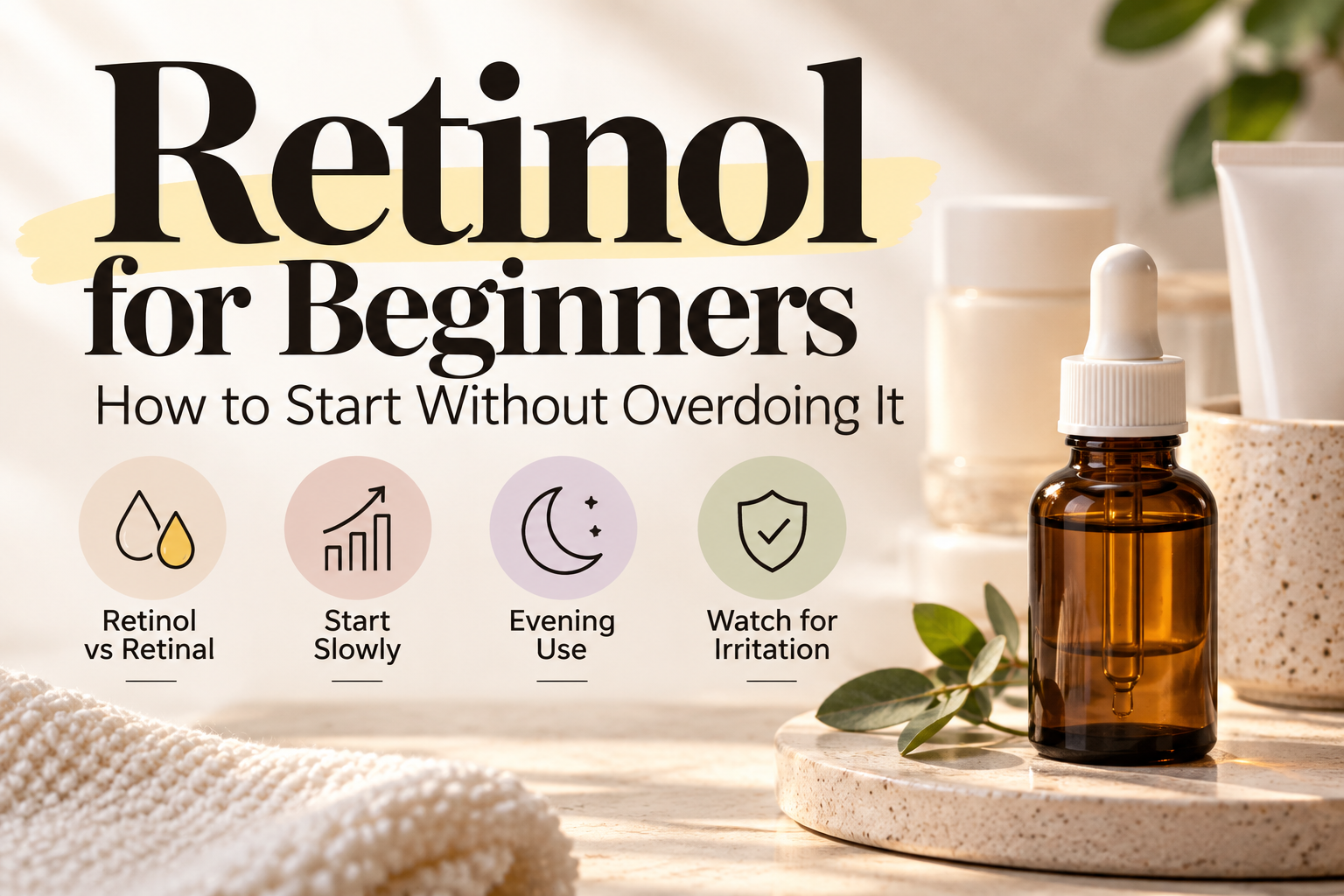
Retinol for Beginners: How to Start Without Overdoing It
Retinol for beginners can be surprisingly confusing.
Start looking for one retinol product and you will quickly come across retinol percentages, retinal, retinoids, tretinoin, “retinol purging,” skin cycling and routines that make a single ingredient seem far more complicated than it needs to be.
But starting retinol does not have to mean building an entirely new skincare routine.
One of the most useful things I have learned from using retinol myself is that doing more is not necessarily better. I currently use it around twice a week as part of my evening routine, followed by moisturizer.
For me, consistency and keeping my skin comfortable matter much more than trying to use retinol as often as possible.
Here is what beginners actually need to know.
What Is Retinol?
Retinol belongs to a larger family of vitamin A derivatives called retinoids.
This is where some of the confusion starts because “retinoid” is an umbrella term rather than one specific ingredient.
Retinol is commonly found in over-the-counter cosmetic skincare products. Other retinoids include retinaldehyde, usually shortened to retinal, as well as prescription medications such as tretinoin.
Retinoids interact with processes involved in skin renewal and have been studied for concerns including photoaging, uneven pigmentation, texture and acne.
That does not mean everyone needs one.
Retinol is an active ingredient, and irritation can happen when it is introduced too aggressively.
What Are the Benefits of Retinol?
One reason retinol remains such a popular skincare ingredient is that it can address several concerns at the same time.
Research on topical retinoids supports potential improvements in concerns such as:
- uneven-looking skin texture
- fine lines associated with photoaging
- uneven pigmentation
- some forms of acne
Clinical research has evaluated different retinol concentrations for photoaged skin, but results depend on the formulation, concentration and study design.
Most importantly, a higher percentage does not automatically mean proportionally better results.
I prefer to think of retinol as a long-term skincare ingredient rather than something that needs to create a dramatic overnight change.
Retinol vs Retinal: What’s the Difference?
This is probably one of the most confusing parts of shopping for vitamin A skincare.
Retinol and retinal are related, but they are not exactly the same ingredient.
A simplified conversion pathway looks like this:
Retinol → Retinal → Retinoic Acid
Retinoic acid is the biologically active form.
Tretinoin is retinoic acid itself, while retinol and retinal need to be converted in the skin.
That means:
Retinol requires two conversion steps before reaching retinoic acid.
Retinal, also called retinaldehyde, requires one.
This difference is useful to understand, but it does not mean you can simply rank every retinal product above every retinol product.
You may see claims online that retinal is exactly “10 times” or “11 times” stronger than retinol. I would not choose a product based on that number alone.
Real skincare products differ in concentration, formulation, stability and delivery system. Those factors can influence both performance and irritation.
Retinol vs Retinal: Which One Should You Choose?
There is no universal winner.
Retinol may make sense if you are new to retinoids and want a widely available ingredient with a long history of cosmetic use.
There are many formulations and concentrations available, which can make it easier to find something that fits your routine.
Retinal may make sense if you are specifically interested in retinaldehyde or have already used retinol successfully and want to explore another over-the-counter retinoid option.
But retinal is not automatically “too strong for beginners,” and retinol is not automatically irritation-free.
Instead of asking only:
“Which one is stronger?”
I think more useful questions are:
What concentration is it?
What is the overall formula like?
How does my skin respond to it?
Can I use it consistently without repeatedly irritating my skin?
Those questions tell you much more about whether a product actually fits your routine.
Retinol for Beginners: What Percentage Should You Use?
You do not need to start with the highest percentage you can find.
A 2022 study compared different retinol concentrations in two separate tests. In a small, 12-day forearm study involving five participants, 0.3% and 1% retinol produced similar changes in some measured skin-remodelling markers. In a separate six-week study involving 218 participants, the 0.3% formulation caused fewer and milder reported adverse reactions than the 1% formulation. These findings do not establish that all 0.3% and 1% retinol products deliver identical visible results.
That does not establish 0.3% as the perfect beginner concentration for everyone.
It reinforces an important point:
Higher is not automatically better.
For a beginner, I would pay attention to the whole formulation and how your skin responds rather than choosing a product based on percentage alone.
If your skin is already very dry, inflamed or irritated, introducing another active may not be the first priority.
How Often Should Beginners Use Retinol?
You do not need to start every night.
Introducing it gradually gives you a chance to see how your skin responds before increasing frequency.
Personally, I use retinol around twice a week as part of my evening routine. That is what currently works for my skin and schedule—not a rule that everyone needs to follow.
If you’re curious about how retinol fits into the rest of my routine, I share the full approach in How to Build a Simple Skincare Routine That Actually Works.
If you are new to retinol, I would focus less on reaching nightly use and more on finding a frequency your skin can tolerate consistently.
There is no prize for getting to seven nights a week.
How Much Retinol Should You Apply?
More product does not mean faster results.
Follow the instructions for the particular product you are using.
With retinoids, unnecessarily applying extra product may increase irritation without giving you a reason to expect proportionally better results.
The goal is generally a thin, even application rather than coating your face in product.
Be particularly careful around areas that tend to become irritated easily, such as the corners of the nose, lips and eye area.
Should You Use Retinol or Retinal at Night?
Retinol and retinal are generally well suited to an evening skincare routine.
But the reason is not that your skin automatically absorbs retinoids better while you sleep.
Retinol and related retinoids can be sensitive to light, and light exposure can contribute to their degradation. This is one reason these ingredients are commonly used at night.
For me, keeping retinol in my evening routine also makes it easier to stay consistent.
I use it around twice a week and follow it with moisturizer rather than trying to fit it into both morning and evening skincare.
A simple routine can therefore look like:
Evening: Cleanse → Retinol or Retinal → Moisturizer
Then use sunscreen during the day.
Always check the instructions for your specific product because formulations can differ.
Where Does Retinol Go in Your Skincare Routine?
For a simple evening routine:
Cleanse → Retinol → Moisturizer
But that is not the only possible order.
If retinol feels too drying or irritating, applying moisturizer first can also be an option.
That might look like:
Cleanse → Moisturizer → Retinol
Some people also prefer a moisturizer-retinoid-moisturizer approach.
You do not need to obsess over one universally correct layering method.
Your product instructions, formulation and skin tolerance matter.
Should You Apply Retinol to Wet or Dry Skin?
Unless your particular product says otherwise, I prefer keeping things simple and applying retinol to dry skin.
You do not need to stand next to a timer waiting for an exact number of minutes.
The practical point is simply that if your skin is easily irritated, there is no need to rush a potentially irritating active onto skin that is still very wet immediately after cleansing.
Let your skin settle, then continue with your routine.
Is “Retinol Purging” Normal?
“Purging” is one of those skincare terms that gets used very casually online.
Because retinoids affect skin-cell turnover and are also used in acne treatment, some people may notice changes in their breakouts after starting a retinoid.
But not every bad reaction is purging.
Increasing redness, burning, persistent stinging, significant peeling or painful irritation should not automatically be treated as something you simply need to push through.
Your skin does not need to become extremely irritated for retinol to be working.
If a product is causing significant or persistent irritation, reduce use or stop and reassess what is happening. If symptoms are severe or do not improve, consider speaking with a dermatologist.
Can You Use Niacinamide With Retinol?
For many people, yes.
There is no general rule that niacinamide and retinol must always be separated.
Niacinamide can fit into the same overall skincare routine as a retinoid.
However, if you are introducing retinol for the first time, I still prefer a simpler approach: do not introduce several unfamiliar active ingredients at the same time.
If irritation develops, it becomes much easier to identify what may have caused it.
Can You Use Vitamin C and Retinol?
You do not necessarily have to choose between vitamin C and retinol.
One simple way to organize them is:
Morning: Vitamin C → Moisturizer → Sunscreen
Evening: Retinol → Moisturizer
That is also close to how I prefer to organize my own routine.
Separating them does not mean modern vitamin C and retinol products are universally incompatible.
For a beginner, it can simply make the routine easier to manage and help avoid piling too many active products into one application.
If vitamin C is already part of your morning routine, my How to Use Vitamin C Serum guide explains how I use it and what I look for in a formula.
What About Azelaic Acid and Other Actives?
Retinol can exist in a skincare routine that also contains ingredients such as azelaic acid, tranexamic acid or other targeted actives.
But that does not mean you need to layer all of them together on the same night.
When you are new to retinol, keeping the routine relatively boring can actually be useful.
Introduce the retinoid.
See how your skin responds.
Then decide whether your routine genuinely needs anything else.
More active ingredients do not automatically create a better skincare routine.
Don’t Forget Sunscreen
If you are investing time in retinol for concerns such as photoaging or uneven pigmentation, sun protection matters.
UV exposure contributes to many of the concerns people are trying to address with retinoids.
Use broad-spectrum sunscreen during the day and remember:
Retinol does not replace sunscreen.
Who Should Be More Careful With Retinol?
Retinol is not appropriate for everyone.
If your skin is already significantly irritated, inflamed or extremely dry, it may make more sense to address that first or discuss retinoid use with a dermatologist.
There is also one particularly important exception:
Retinoids should be avoided during pregnancy.
The American Academy of Dermatology recommends avoiding prescription retinoids as well as over-the-counter skincare containing retinol during pregnancy.
If you are pregnant, trying to become pregnant or unsure whether a particular vitamin A product is appropriate for you, speak with your doctor or dermatologist.
What I Would Do If I Were Starting Retinol Again
I would make it much less complicated than social media sometimes makes it sound.
I would choose one retinoid product, not several.
I would start slowly instead of immediately trying to use it every night.
I would keep the rest of my evening routine gentle and make sure I already had a moisturizer that worked well for my skin.
I would not increase the concentration just because my skin stopped feeling irritated.
And I would judge the routine over time rather than expecting visible changes after a few applications.
After years of experimenting with skincare around an irregular schedule, I have become much more interested in what I can use consistently than in creating the most aggressive routine possible.
The Bottom Line
Retinol for beginners does not need to be complicated.
Retinol and retinal are both vitamin A derivatives used in skincare, but retinal sits one conversion step closer to retinoic acid.
That difference is worth understanding, but it does not mean everyone should automatically choose retinal.
If you are starting a retinoid, focus on the basics:
Choose one product. Start gradually. Use it at night. Moisturize. Pay attention to irritation. Use sunscreen during the day.
You can always adjust your routine later.
Starting stronger is easy.
Finding a routine your skin can actually tolerate and maintain is usually more valuable.