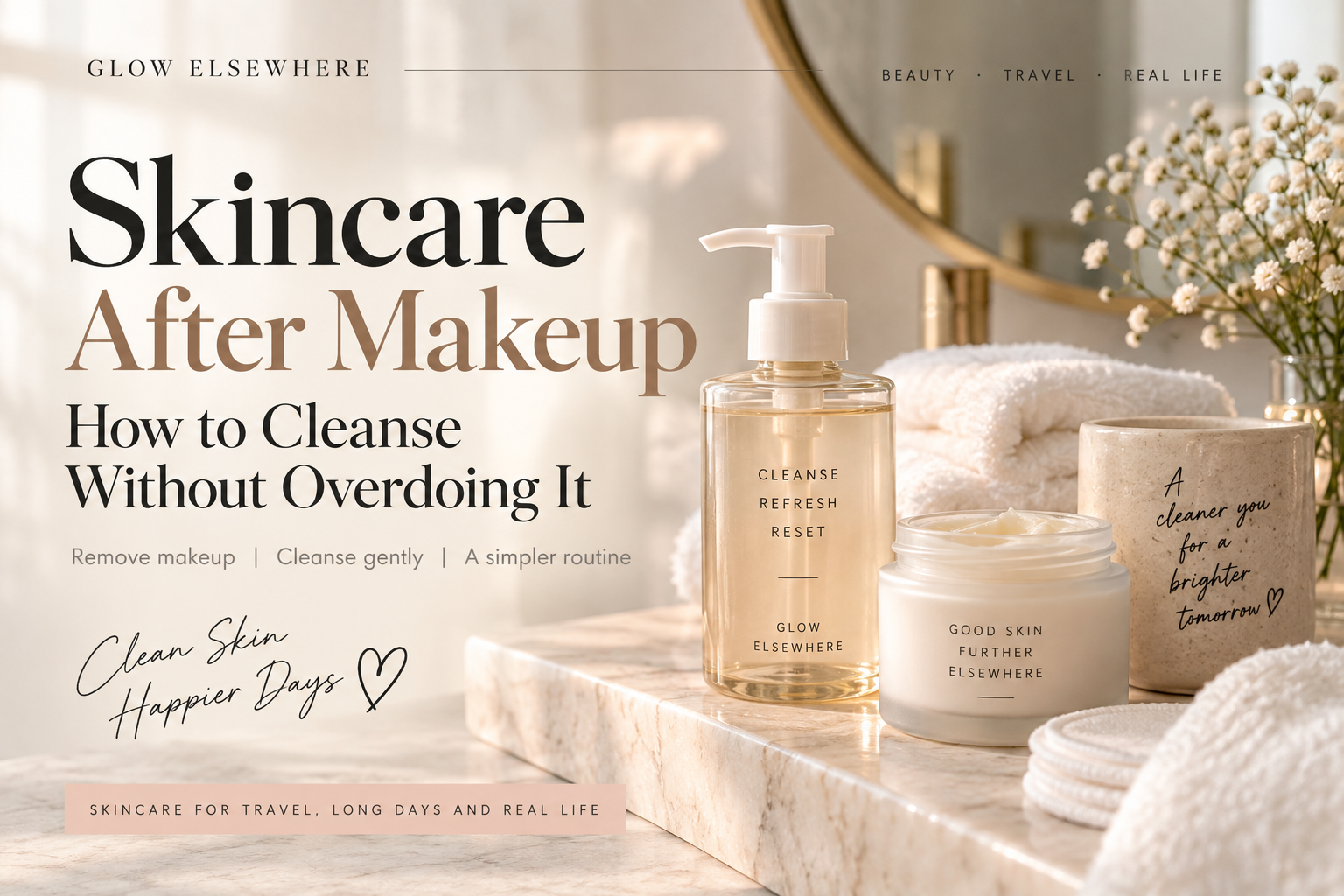
Skincare After Makeup: How to Cleanse Without Overdoing It
Skincare after makeup doesn’t need to be complicated. After removing makeup, it can be tempting to give your skin an extra-deep cleanse.
I understand the feeling. After a flight or a long day in makeup, the first thing I want to do is get everything off my face.
But cleansing harder doesn’t necessarily mean cleansing better.
The goal is much simpler: remove makeup and sunscreen thoroughly, cleanse gently and follow with a routine your skin already tolerates.
After almost five years of working in makeup as cabin crew, this has become one of the most consistent parts of my nighttime routine.
Start by Removing Makeup and Sunscreen
My first step is removing makeup and sunscreen properly.
I personally rotate between cleansing milk, cleansing oil and cleansing balm. I don’t have a strict rule about which one I use—I usually choose from what I already have.
I apply my first cleanser to dry skin and gently massage it over my face. When I use an oil or balm, I add water to emulsify it before rinsing.
The goal isn’t to scrub my skin until it feels squeaky clean. It’s simply to loosen and remove what I’ve been wearing.
I’ll compare cleansing oil, balm and milk separately because each can fit differently into a routine.
Do You Need to Double Cleanse After Makeup?
Not necessarily every time.
I personally double cleanse after wearing makeup, especially after work when I’ve had it on for many hours.
After removing my makeup, I follow with a gentle, mildly acidic facial cleanser and lukewarm water.
Double cleansing can be useful for removing makeup and water-resistant sunscreen, but it isn’t automatically necessary for everyone. Over-cleansing can also leave some skin feeling dry or irritated.
For me, two steps work well after makeup.
The important part is not the number of cleansers you use. It’s whether you’ve removed what you were wearing without unnecessarily rubbing or repeatedly washing your skin.
Clean Doesn’t Have to Mean Stripped
This is where I think it’s easy to overdo things.
If your face feels extremely tight after cleansing, don’t automatically assume that means your skin is especially clean.
Hot water, aggressive rubbing and washing too frequently can contribute to dryness and irritation. Gentle cleansing and lukewarm water are generally better choices.
I now pay more attention to whether my makeup has actually been removed than trying to achieve a particular squeaky-clean feeling.
Clean is the goal. Stripped isn’t.
What Should You Do After Removing Makeup?
Once my makeup is completely off, I keep the rest of my routine relatively simple.
After work, I usually use:
Sheet mask → ampoule → cream
The sheet mask is optional.
If I’m exhausted, that’s the first thing I skip.
What I don’t skip is removing my makeup.
My personal rule is:
There’s no point in putting good skincare on top of skin I haven’t properly cleansed. I want to remove makeup and buildup first, then start my nighttime skincare on clean skin.
That’s my personal approach—not a claim that cleansing automatically makes every skincare ingredient work better.
Don’t Compensate With Too Many Products
After wearing makeup for hours, you might feel as though your skin suddenly needs everything.
An exfoliant, a mask, several serums, a strong active and a heavy cream can quickly turn a simple nighttime routine into a lot for your skin at once.
I don’t approach my post-makeup routine that way anymore.
If my skin already feels dry or uncomfortable, I’d rather use a few familiar products than suddenly add several treatments.
More products don’t automatically mean better recovery.
My Post-Flight Routine
After a flight, my routine usually looks like this:
First cleanse → gentle second cleanse → sheet mask → ampoule → cream
If I’m very tired, I simplify the steps after cleansing.
This routine has become especially useful for me because some workdays involve wearing makeup for many hours in a dry aircraft cabin.
Earlier in my career, I was less consistent with skincare. Over time, I’ve found that a simple routine I can actually repeat works better for me than constantly changing products or adding extra steps.
What About Eye and Lip Makeup?
I don’t normally use a separate eye and lip makeup remover.
But that doesn’t mean everyone should skip one.
If waterproof mascara, eyeliner or long-wear lipstick isn’t coming off easily, repeatedly rubbing the area isn’t a good solution.
Using a remover that can take off stubborn makeup more easily may make more sense than forcing your regular cleanser to do everything.
The goal isn’t to use the fewest products possible. It’s to remove your makeup effectively without unnecessary friction.
A Simple Skincare Routine After Makeup
If you’re not sure what to do, keep it simple:
Remove makeup and sunscreen thoroughly.
Cleanse gently rather than scrubbing.
Pay attention to how your skin feels after washing.
Follow with moisturizing products your skin already tolerates.
Don’t add extra treatments simply because you’ve worn makeup.
If your skin repeatedly becomes painful, very dry, cracked, itchy or inflamed despite using a gentler routine, it may be worth discussing it with a dermatologist.
The Bottom Line
Skincare after makeup doesn’t need to be complicated.
The priority is removing what you’ve been wearing without turning cleansing into another source of irritation.
I personally double cleanse after makeup, then follow with a simple routine. After long workdays, I may add a sheet mask when I have the time and energy.
Your routine doesn’t need to look exactly like mine.
A good post-makeup routine is one that removes your makeup effectively, feels comfortable on your skin and is simple enough to repeat consistently.