Mineral vs Chemical Sunscreen: Which Is Right for You?
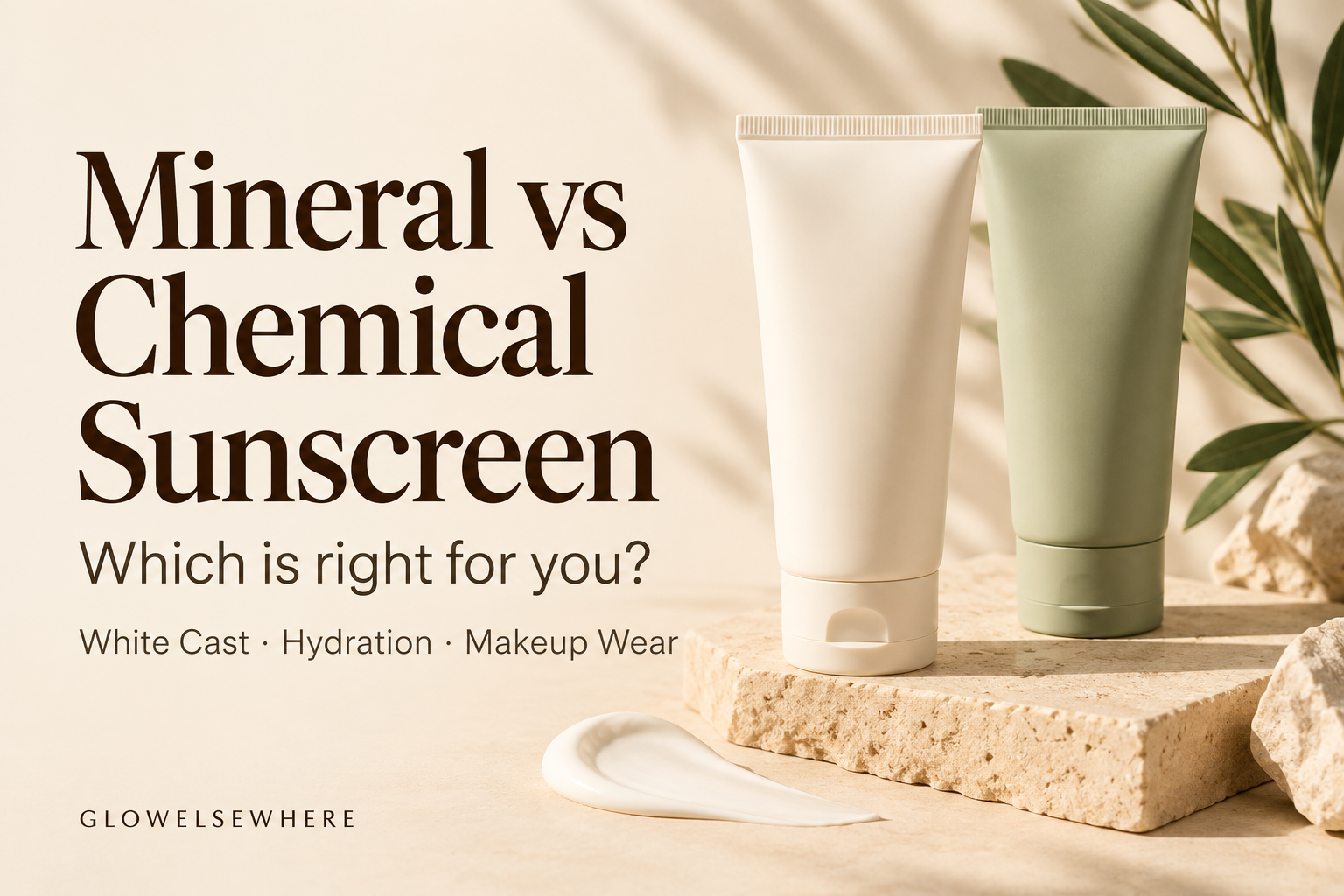
When comparing mineral vs chemical sunscreen, it helps to look beyond the filter category. Does the product leave a white cast? Does your skin feel comfortable? Does it sit well under makeup?
I have oily but dehydrated skin, so hydration and finish matter to me alongside sun protection. Here is how the different sunscreen categories fit together—and how I choose products for everyday wear and flight days.
Mineral vs Chemical Sunscreen: What Is the Difference?
The main difference is the type of UV filters used.
Mineral sunscreens use zinc oxide, titanium dioxide, or both. You may also see them described as inorganic or physical sunscreens.
Chemical sunscreens use organic UV filters. Here, “organic” describes a chemical category; it does not mean organically farmed. Likewise, “chemical” does not automatically mean harmful.
Hybrid sunscreens combine mineral and chemical filters. A product containing zinc oxide is therefore not necessarily mineral-only.
Do Mineral Sunscreens Reflect UV While Chemical Sunscreens Absorb It?
This common explanation is an oversimplification.
Zinc oxide and titanium dioxide protect primarily by absorbing UV radiation, although they also scatter and reflect some light. Mineral sunscreen does not simply act like a mirror on your skin. (pubmed.ncbi.nlm.nih.gov)
The finished product’s protection rating and how you apply it are more useful selection criteria than this simplified distinction.
Where Do Hydrating and Tone-Up Sunscreens Fit In?
“Hydrating” and “tone-up” describe different features from “mineral” and “chemical.”
| Term | What it describes |
| Mineral, chemical or hybrid | The types of UV filters used |
| Hydrating sunscreen | A formula emphasizing moisture and a hydrated feel |
| Tone-up sunscreen | A formula designed to make the complexion appear brighter or more even |
A hydrating or tone-up sunscreen can use mineral, chemical or hybrid filters. One product can also offer both hydration and a tone-up effect.
In Korean skincare, “tone-up” usually describes an immediate cosmetic brightening effect. It does not necessarily mean the product matches your skin tone or provides a moisturizing finish.
Check the protection label separately: brighter-looking skin is not evidence of stronger sun protection.
Mineral vs Chemical Sunscreen: A Practical Comparison
| Consideration | Mineral sunscreen | Chemical sunscreen |
| White cast | May be noticeable, depending on the formula and skin tone | Often less noticeable, although added pigments can change the finish |
| Texture | Ranges from matte to moisturizing | Ranges from lightweight to rich |
| Sensitive skin | An option to consider if sunscreen stings your skin | Suitability depends on the formula and individual tolerance |
| Makeup compatibility | Depends on the formula and products underneath | Depends on the formula and products underneath |
These are general tendencies. Mineral sunscreen is not always drying, and chemical sunscreen is not always irritating.
If White Cast Is Your Main Concern
Some mineral formulas can leave a pale or grayish appearance. A tinted sunscreen that matches your complexion may help; the American Academy of Dermatology suggests this option for people bothered by white residue. (aad.org)
Check the finish around your hairline and where your face meets your neck. Rather than applying less to hide the cast, choose a formula that looks comfortable on your skin when applied generously.
If Sunscreen Stings Your Skin
The American Academy of Dermatology recommends considering a fragrance-free sunscreen whose UV filters are only zinc oxide and titanium dioxide if sunscreen makes your skin sting or burn. (aad.org)
That does not guarantee every mineral formula will suit you. Eye discomfort also cannot be predicted from the filter category alone. Follow the product’s directions around the eyes, avoid getting sunscreen into them, and change products if discomfort keeps recurring.
How I Choose Sunscreen for Daily Life and Flight Days
I Prefer SPF 50+ PA++++
I usually look for SPF 50+ PA++++ because a higher protection rating gives me more reassurance.
SPF primarily describes protection against UVB-induced sunburn, while PA indicates UVA protection. PA++++ is the highest category in the PA labeling system. (jcia.org)
However, I do not treat a high rating as a reason to skip reapplication.
For Everyday Wear, I Like Mineral or Tone-Up Sunscreen
I tend to prefer mineral sunscreen because the formulas I enjoy leave my complexion looking slightly more even—as though I have applied a light base. I also reach for tone-up sunscreen on days when I do not want much additional makeup.
This is a personal preference about appearance. Not every mineral formula gives that effect, so I look for one that works with my skin tone without looking chalky.
Before Makeup and Flight Shifts, I Prioritize Hydration
Before makeup, especially when preparing for a flight shift, I prefer a hydrating sunscreen or a moisturizing tone-up formula.
My skin can be oily and still feel tight. When I will be wearing makeup for hours in a dry cabin, I pay particular attention to moisture and comfort rather than choosing solely for a matte finish.
I moisturize first, apply sunscreen, and let it settle before starting makeup. With tone-up products, I check the moisturizing feel as carefully as the color effect.
For the order of these steps, see How to Layer Skincare Products.
I Use Sun Sticks or Sun Cushions for Touch-Ups
When I am out, I sometimes reapply using a sun stick or sun cushion because they are convenient to carry.
A quick swipe or a few taps, however, may not provide enough coverage. Follow the product’s directions and apply evenly without missing areas.
For sunscreen sticks, the American Academy of Dermatology recommends four passes back and forth over each area, followed by rubbing the sunscreen in for even coverage. Cushions have a different application method, so follow their specific instructions rather than using the same number of passes. (aad.org)
What to Check With Oily but Dehydrated Skin
Instead of looking only for an “oil-control” label, consider how the sunscreen wears throughout the day:
- Can you apply enough without it feeling heavy?
- Does your skin become tight or uncomfortable?
- Does it sit well over your usual moisturizer?
- Does foundation or cushion makeup apply smoothly on top?
If sunscreen pills, review the amount and combination of skincare underneath before reducing the sunscreen. Keep it as a separate step rather than mixing it with moisturizer or foundation.
Protection and Application Come First
Whatever filter type you choose, the American Academy of Dermatology recommends SPF 30 or higher, broad-spectrum UVA/UVB protection, and water resistance. (aad.org)
Apply generously before going outdoors—generally about 15 minutes beforehand—and follow the product’s instructions. When outdoors, reapply approximately every two hours and after swimming or sweating. Use shade, hats and protective clothing alongside sunscreen. (aad.org)
There is no universal winner in the mineral vs chemical sunscreen comparison. Choose adequate protection in a formula that suits your skin, works with your routine, and feels comfortable enough to apply generously and use consistently.