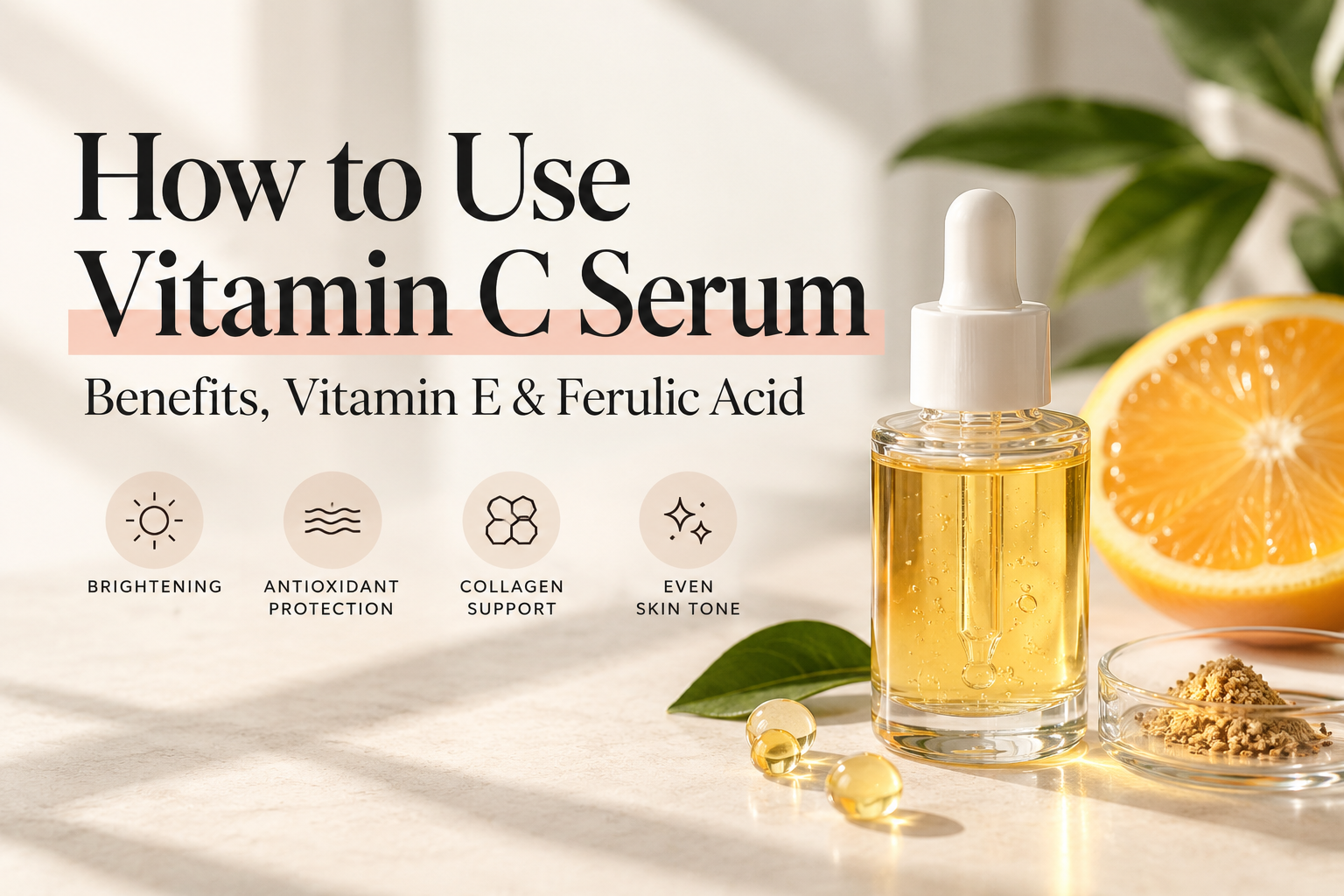
How to Use Vitamin C Serum: Benefits, Vitamin E & Ferulic Acid
Using vitamin C serum correctly can make it easier to include this ingredient in a consistent skincare routine. Vitamin C is one of the skincare ingredients I use consistently.
I usually include vitamin C in my morning routine. In the past, though, I mostly looked for one thing when choosing a product: Does it contain vitamin C?
The more I learned about the ingredient, the more my approach changed.
Now I look at the form of vitamin C, the concentration, the overall formula and packaging. I also tend to check for vitamin E and ferulic acid.
That doesn’t mean a vitamin C serum needs both ingredients to be good. But there are interesting reasons why vitamin C, vitamin E and ferulic acid are so often formulated together.
So, what does vitamin C actually do for the skin, how should you use it, and what should you look for in a formula?
What Does Vitamin C Do for Your Skin?
Vitamin C is best known in skincare as an antioxidant.
Antioxidants help address oxidative stress caused by factors such as UV exposure and environmental stressors. Vitamin C also plays a role in collagen synthesis and can affect pathways involved in melanin production, which is why it is often used in skincare routines focused on uneven-looking tone and signs of photoaging.
But vitamin C isn’t something I expect to transform my skin overnight.
Skincare results take time, and with vitamin C, I care more about finding a formula my skin tolerates well enough to use consistently than expecting an immediate change.
Not All Vitamin C Is the Same
One reason shopping for vitamin C can get confusing is that not every product uses the same form.
One of the best-known and most studied forms is L-ascorbic acid, sometimes simply listed as ascorbic acid.
L-ascorbic acid has plenty of research behind it, but it also has a drawback: it can be difficult to formulate because it is relatively unstable and can be affected by factors such as light, heat and oxygen.
There are also vitamin C derivatives used in skincare, which can have different stability and formulation characteristics.
That’s why I don’t think two products should be compared only by the percentage printed on the label.
The form of vitamin C, concentration, formulation and packaging all matter.
Is a Higher Vitamin C Percentage Better?
Not necessarily.
It can be tempting to assume that a 20% vitamin C serum must be better than a 10% serum, but skincare doesn’t always work that way.
Higher concentrations can also be more irritating for some skin types. If you’re new to vitamin C or have sensitive skin, you don’t necessarily need to start with the strongest formula you can find.
This is something I’ve come to value with skincare in general:
A product you can use consistently is often more practical than a stronger product you can’t comfortably tolerate.
Pay attention to how your own skin responds rather than choosing a product based on concentration alone.
Why Is Vitamin E Often Paired With Vitamin C?
If you look closely at vitamin C serum ingredient lists, you may also see vitamin E, often listed as tocopherol.
Both vitamin C and vitamin E are antioxidants, and they can work in complementary antioxidant systems. Research has described vitamin C’s role in helping regenerate oxidized vitamin E.
This is one reason the combination has been studied and used in antioxidant skincare formulations.
And it’s also one of the things I now look for when I’m shopping for vitamin C.
However, there’s an important distinction:
A vitamin C product isn’t automatically ineffective just because it doesn’t contain vitamin E.
The performance of a formula depends on much more than the presence or absence of one additional ingredient.
What Does Ferulic Acid Do With Vitamin C?
The other ingredient I pay attention to is ferulic acid.
Ferulic acid is another antioxidant, and there’s a reason it frequently appears alongside vitamins C and E.
A frequently cited study examined a formula containing 15% L-ascorbic acid and 1% alpha-tocopherol, a form of vitamin E. Adding ferulic acid improved the chemical stability of the vitamins and increased photoprotection under the study conditions.
That helps explain why you often see the combination of:
Vitamin C + Vitamin E + Ferulic Acid
in antioxidant skincare formulas.
But there’s an important limitation here too.
The findings from a specific formulation don’t mean that every vitamin C serum needs ferulic acid or that a product without it is automatically inferior.
Modern skincare products use different forms of vitamin C and different formulation and stabilization strategies.
The entire formula still matters.
Why I Look for Vitamin E and Ferulic Acid in My Vitamin C Serum
This is where the research influences my personal product choices.
Before I learned more about vitamin C formulations, I mainly focused on vitamin C itself.
Now, when I shop for a vitamin C serum, I usually check the ingredient list for vitamin E and ferulic acid, too.
Because of what we know about the complementary antioxidant relationship between vitamins C and E, along with research on formulations combining vitamin C, vitamin E and ferulic acid, I personally prefer products that include all three when I can find a formula that works for my skin.
But that’s my selection preference, not a rule everyone needs to follow.
There can absolutely be well-formulated vitamin C products without this exact combination.
For me, it’s simply become more useful to look at the whole formula rather than buying something because it has a high vitamin C percentage on the front of the bottle.
How to Use Vitamin C Serum in the Morning
Vitamin C can be used in different routines, but I personally use it in the morning.
My basic order is:
Cleanse → Toner, if needed → Vitamin C serum or ampoule → Moisturizer → Sunscreen
Vitamin C’s antioxidant activity is one reason it is commonly incorporated into morning skincare alongside sun protection.
But there’s one point that’s especially important:
Vitamin C does not replace sunscreen.
Think of vitamin C as an antioxidant step that can complement your morning routine, not as an alternative to UV protection.
If you’re unsure about the general order of the rest of your products, I have a separate guide on How to Layer Skincare Products rather than trying to turn this vitamin C guide into another full layering routine.
What If You’re New to Vitamin C?
You don’t need to introduce several new active ingredients at the same time.
Adding one new product at a time makes it easier to see how your skin responds and identify what might be causing irritation if something goes wrong.
If vitamin C causes persistent stinging, redness, itching or significant dryness, don’t assume you need to push through it just because the ingredient is popular.
Reduce the frequency or stop using it if necessary.
I also prefer to keep my own active-ingredient routine fairly organized.
I generally use vitamin C in the morning, niacinamide in my evening routine and retinol around twice a week rather than trying to pile everything into one routine.
For me, skincare works better when I can maintain it consistently.
How Should You Store Vitamin C Serum?
Storage matters, particularly with formulas containing L-ascorbic acid.
Because this form of vitamin C can be sensitive to light, heat and oxygen, I look not only at the ingredient list but also at the packaging.
Follow the storage instructions provided for the specific product, keep it away from unnecessary heat and direct light, and make sure the container is properly closed.
If the color, smell or texture changes significantly from when you first opened the product, check the manufacturer’s storage guidance and recommended period of use.
Packaging won’t tell you everything about the quality of a formula, but it’s one more factor worth considering.
What I Check Before Choosing a Vitamin C Serum
My checklist has changed quite a bit from when I first started using vitamin C.
Instead of asking only, Does this contain vitamin C?, I now think about:
Form of vitamin C → Concentration → Overall formula → Vitamin E → Ferulic acid → Packaging → How my skin tolerates it
Personally, I prefer to choose a vitamin C product that also contains vitamin E and ferulic acid when the overall formula suits my skin.
But I wouldn’t reject an otherwise good vitamin C product solely because one of those ingredients is missing.
Ultimately, the most important question is still:
Can my skin tolerate this product well enough for me to use it consistently?
A formula can look perfect on paper, but if it continually irritates my skin, it isn’t the right product for me.
The Bottom Line
Choosing a vitamin C serum doesn’t have to come down to finding the highest percentage.
The form of vitamin C, concentration, formulation, stability, packaging and your own skin tolerance all deserve consideration.
There are scientific reasons why vitamin C, vitamin E and ferulic acid are frequently formulated together. That’s why I personally check for vitamin E and ferulic acid when choosing a vitamin C product and tend to prefer formulas that contain them.
But I treat that as a personal selection criterion, not a universal formula for finding the “best” vitamin C serum.
No matter which formula you choose, consistency and skin tolerance still matter.
And if you’re using vitamin C as part of your morning routine, don’t forget the final step:
Vitamin C → Moisturizer → Sunscreen.
Vitamin C complements sun protection. It doesn’t replace it.