How I Make My Makeup Last on Long-Haul Flights Without Powder or Setting Spray
Long-haul flight makeup is often described as something that needs to be heavily layered, powdered and locked in place with setting spray.
That has not been my experience.
After nearly five years of working as cabin crew on short-haul, long-haul and ultra-long-haul flights, I rarely use primer, setting powder or setting spray. My makeup does not look exactly the same at the end of a flight—and I do not expect it to.
My goal is more realistic: I want my makeup to remain presentable without making my skin feel excessively dry or uncomfortable.
My skin is oily but dehydrated, sensitive and acne-prone. During a long flight, my forehead can become shiny while my cheeks and the area around my mouth still feel dry. Foundation may collect around my smile lines, and the base on my cheeks can begin to separate.
Over time, I have found that adding more makeup is not always the answer. What works better for me is preparing my skin carefully, applying less base makeup and using a light face mist when my skin needs a refresh.
How My Long-Haul Flight Makeup Changes Over Time
My makeup does not break down evenly across my face.
My lips usually feel dry first. After a few hours, my cheeks and mouth area may begin to feel slightly tight. Later in the flight, oil can appear on my forehead even though other areas still feel dehydrated.
After wearing makeup for many hours, I tend to notice:
- Dry lips
- Foundation settling around my smile lines
- Shine across my forehead and nose
- Base makeup moving slightly on my cheeks
- Dryness becoming more visible around my mouth
- Increased sensitivity when I am particularly tired
I used to think I needed more powder to control these changes. However, powder often made the drier parts of my face look more noticeable later.
Now, instead of trying to prevent every sign of wear, I focus on helping my makeup change more naturally.
1. I Keep My Pre-Flight Skincare Simple
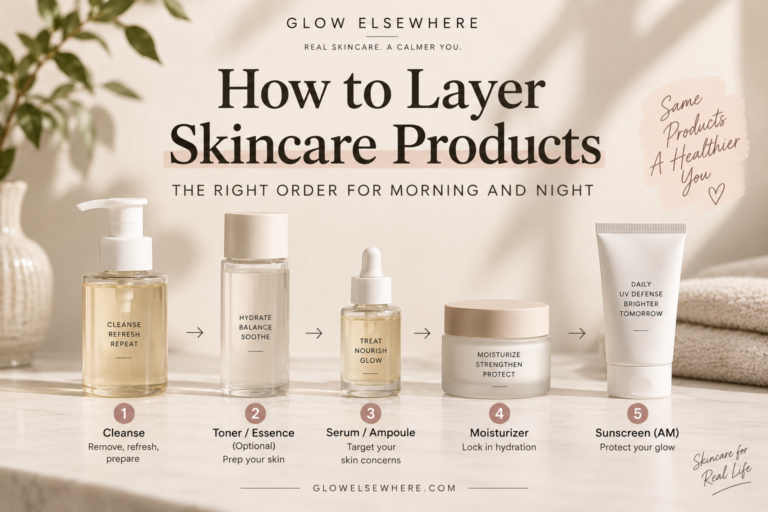
My pre-flight skincare routine currently includes Mamonde Liquid Mask Peony, AESTURA ATOBARRIER365 Cream and athé’s Vegan Relief mineral sunscreen. I choose this combination for how it feels on my skin and how it sits underneath makeup.
First step: Mamonde Liquid Mask Peony
I use this as my first skincare step, with the aim of managing shine and preparing my oily skin for makeup. This is why I include it in my routine—not a claim that it will control oil or prevent makeup breakdown for everyone.
Moisturizer: AESTURA ATOBARRIER365 Cream
I still use this cream, although I preferred the version before the reformulation. The previous formula felt richer and more cushiony to me, and it seemed to relieve that tight, dehydrated feeling more effectively.
That is a comparison of how the two versions felt on my skin, rather than proof that the older formula moisturized better. The current version still works reasonably well for me, particularly because it sits under my makeup without pilling when I apply a suitable amount and let it settle.
Sunscreen: athé Vegan Relief mineral sunscreen
This sunscreen spreads easily and feels light and comfortable on my sensitive skin. Those qualities make it a practical choice for me before makeup. My experience does not mean it will suit every person with sensitive skin.
What matters as much as the products
Even when I like every product in a routine, applying too much or rushing the layers can still lead to pilling. I pay attention to the amount of each skincare product and allow the layers to settle before continuing. That does not mean reducing sunscreen below its recommended application amount to improve my makeup.
For me, a comfortable routine depends on both the products and how I apply them.
If cabin dryness is your main concern, my guide to dry skin after flying covers my routine before, during and after a flight.
2. I Usually Skip Primer
Primer can be useful for oil control, pore smoothing or giving makeup extra grip. I simply do not find it necessary for my routine.
When I layer skincare, sunscreen, primer and foundation, my base can feel too heavy or begin to move. Instead of adding primer, I check whether my skincare has settled before applying foundation.
If my moisturizer or sunscreen still feels sticky, I wait a little longer.
For my skin, giving the previous layers enough time to absorb makes a greater difference than adding another product between my sunscreen and foundation.
3. I Apply a Thin Layer of Foundation or Cushion
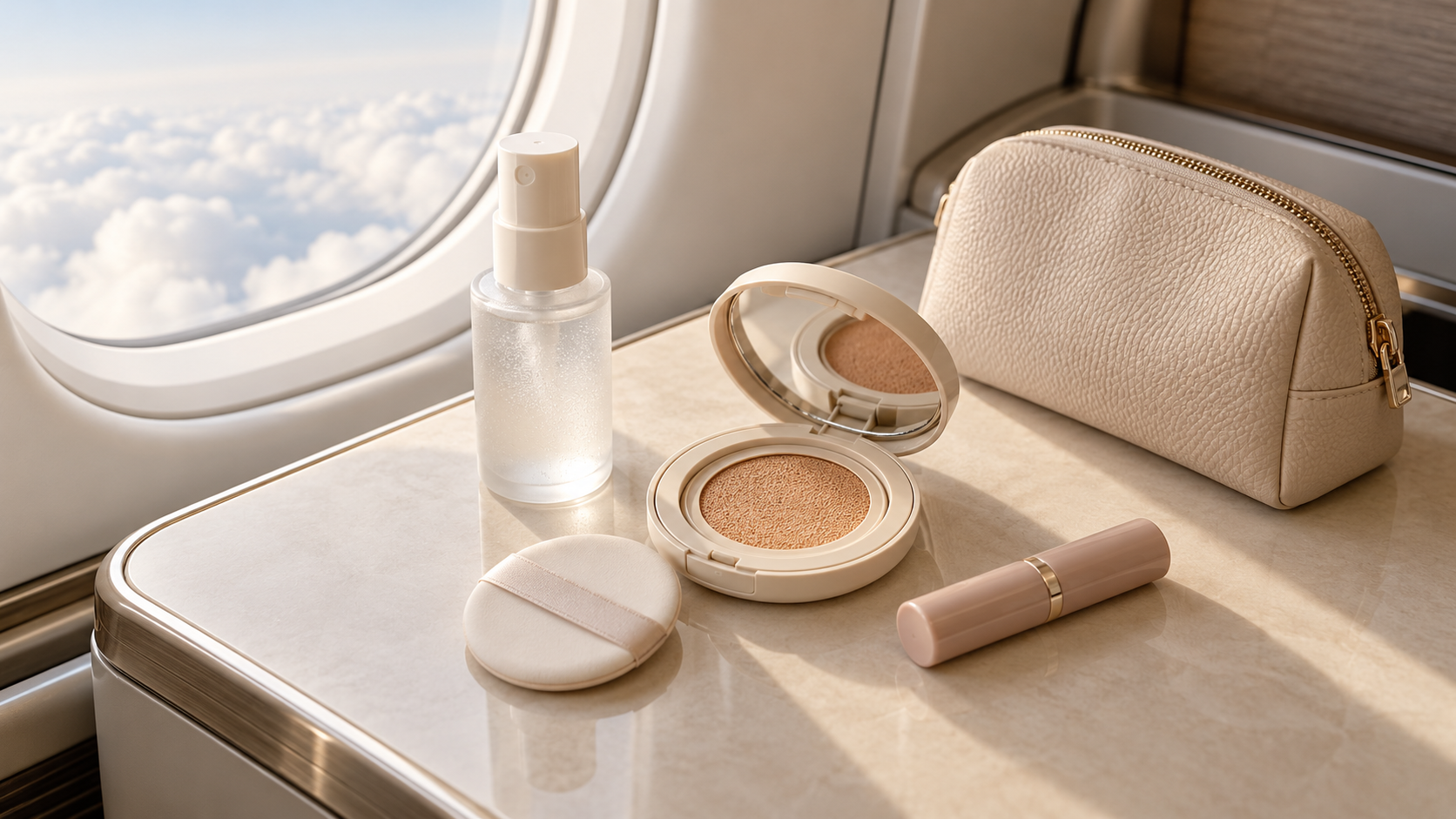
The cushion I currently use is JUNG SAEM MOOL Essential Skin Nuder Cushion. I like its shade selection and the balance of a moisturizing feel with good coverage.
What matters most to me on a long flight is how it wears over time. On my skin, this cushion wears down in a way I still find flattering, even after many hours. That does not mean it stays freshly applied or completely unchanged throughout the flight.
I keep the base layer light rather than applying extra coverage everywhere at the start. My skincare underneath also matters: even a cushion I enjoy can sit poorly if I have applied too much cream or have not given the earlier layers enough time to settle.
For me, the combination works because the skincare feels comfortable underneath and I like how the cushion looks as it gradually wears.
4. I Do Not Try to Eliminate Every Trace of Shine
Because my forehead becomes oily, it may seem as though I need setting powder.
But my skin is oily and dehydrated at the same time. If I powder my entire face based only on the shine around my T-zone, my cheeks and mouth can look drier later.
That is why I usually skip setting powder.
This is a personal preference, not a rule. Someone with consistently oily skin may feel more comfortable using a small amount. In that case, concentrating it around the T-zone may work better than applying a heavy layer across the entire face.
I have learned that a little natural shine does not necessarily mean my makeup has failed. I would rather see some shine than have a base that looks thick, dry and uncomfortable.
5. I Do Not Depend on Setting Spray
Setting spray can help hold makeup in place, but makeup longevity and skin comfort are not the same thing.
A setting spray may reduce movement on the surface, but it does not replace balanced skincare underneath. For my skin, heavily fixing the makeup does not prevent my cheeks or mouth area from feeling dry several hours later.
I prefer to keep the layers light and allow a small amount of natural movement. This also makes it easier to correct one area without disturbing multiple layers of product.
6. I Use a Face Mist During the Flight
A face mist is one of the few skincare products I recommend using during a long-haul flight, especially when my skin begins to feel tight.
I choose a fine, familiar mist that I have already tested on my sensitive, acne-prone skin. I spray it lightly from a comfortable distance instead of using so much that my makeup becomes wet.
A light mist helps my skin feel refreshed without requiring me to rub my face or apply a thick layer of cream over my makeup. After spraying, I allow it to settle naturally rather than touching my skin.
My in-flight routine remains simple:
- I use a light face mist when my skin feels tight or uncomfortable.
- I reapply lip balm whenever my lips feel dry.
- I avoid touching or rubbing my face.
- I do not repeatedly add cushion or foundation over separating makeup.
A mist does not replace my moisturizer or pre-flight skincare. However, it is a practical way for me to refresh my skin while wearing makeup.
The key is to use a product that I already know suits my skin and apply it lightly rather than soaking my face.
7. I Accept That Long-Haul Makeup Will Change
No makeup can remain completely untouched throughout a long flight.
Dry cabin air is only part of the experience. Long working hours, irregular meals, limited rest, facial expressions and constant movement can all affect the way makeup looks.
My forehead may become shiny. Foundation may settle slightly around my smile lines. The base on my cheeks may no longer look as smooth as it did at the beginning.
If one area looks noticeably creased or uneven, I correct only that section instead of applying another layer across my whole face.
I am not trying to make my skin look as though the makeup was applied five minutes ago. I want it to remain neat, light and comfortable after many hours of wear.
That is a more realistic standard for me than expecting perfection.
8. I Remove My Makeup Carefully After the Flight
After wearing sunscreen and makeup for many hours, I try not to fall asleep without removing them—even when I am tired.
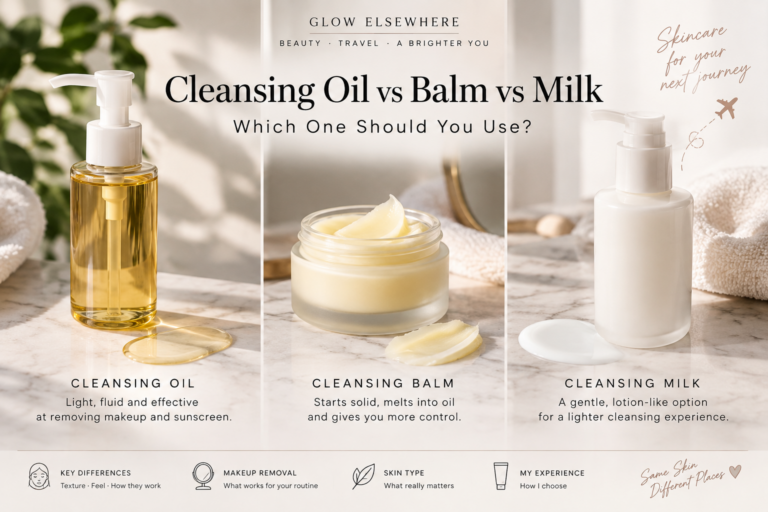
I begin on a dry face with a cleansing milk, oil or balm, depending on the makeup I wore and how my skin feels. I massage it gently, add water to emulsify it and rinse thoroughly.
I then use a mild, low-pH facial cleanser as my second cleanse. I do not scrub my skin in an attempt to make it feel extremely clean.
After cleansing, I may use a familiar sheet mask if my skin feels particularly dry. Otherwise, I apply a hydrating ampoule and moisturizer.
If my skin feels sensitive, I temporarily pause retinol, strong exfoliants and active products that sting. I return to them when my skin feels comfortable again.
My guide to cleansing oil vs balm vs milk explains how I choose my first cleanser according to my makeup and skin condition.
What May Work Differently for Your Skin
This routine is based on my own oily but dehydrated, sensitive and acne-prone skin.
Someone with very dry skin may need a richer moisturizer. Someone with consistently oily skin may prefer a small amount of powder around the T-zone. Climate, makeup formulas and flight length can also change how a routine performs.
The most useful approach is to observe how your own makeup changes:
- Which area becomes dry first?
- Where does oil appear?
- Does foundation crease because too much was applied?
- Do your skincare and sunscreen layers have time to absorb?
- Does powder improve your makeup or emphasize dryness?
- Which products still feel comfortable after several hours?
A popular cabin crew product or viral technique is not automatically the best choice for every skin type.
I developed this routine by noticing the same patterns over many flights—not by finding one product that made my makeup completely transfer-proof.
What Nearly Five Years of Flying Has Taught Me
Long-haul flight makeup does not need to be heavily fixed to wear reasonably well.
For my skin, these habits make the greatest difference:
- Keeping my pre-flight skincare gentle and familiar
- Allowing skincare and sunscreen to absorb
- Applying a thin layer of foundation or cushion
- Avoiding excess product around moving areas
- Using a light face mist when my skin needs refreshing
- Not treating every trace of shine as a problem
- Removing my makeup carefully after landing
I fly without primer, setting powder or setting spray because that is what currently works for my skin. It is not the only correct way to do long-haul makeup.
The goal is to find a balance between makeup longevity, appearance and comfort.
For me, that balance comes from using the right amount—not automatically adding more.
My skin needs consistency, not complexity.