Copper Peptides for Skin: Benefits, Limits and How to Use Them
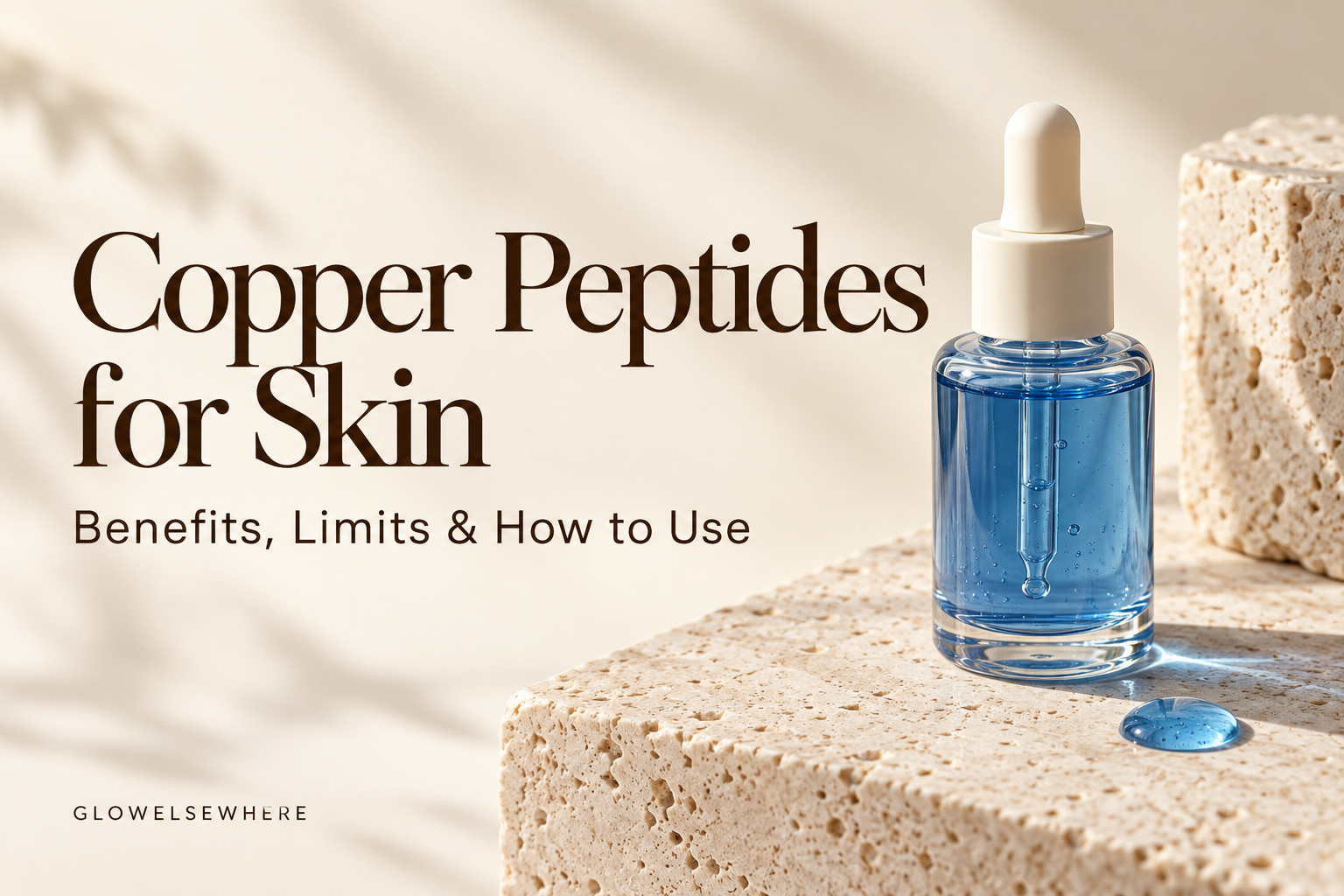
If you have been researching copper peptides for skin, you may have come across GHK-Cu, an ingredient often featured in serums marketed for fine lines, firmness and smoother-looking skin.
But what makes copper peptides different from other peptides—and how much can you realistically expect from a serum?
Copper peptides have an interesting research background. The useful distinction is between what an ingredient does in a laboratory and what a finished product has been shown to do on human skin.
Here is what to know before adding one to your routine.
What Are Copper Peptides?
Peptides are short chains of amino acids. Skincare products contain different types, and they do not all have the same function or evidence behind them.
Copper peptides are peptides that bind copper ions. One of the best-known examples is GHK-Cu: a complex formed when the three-amino-acid peptide GHK binds copper. GHK stands for glycine, histidine and lysine.
In a cosmetic ingredient list, you may see the name Copper Tripeptide-1.
A product labelled “peptide serum” does not necessarily contain copper peptides. Checking the ingredient list tells you more than the name on the front of the bottle.
Copper Peptides for Skin: What Benefits Can You Expect?
Laboratory research suggests a role in collagen-related processes
One reason GHK-Cu attracts attention is its relationship with collagen, a structural protein in skin.
Research using cultured fibroblasts—the cells involved in producing skin’s supporting matrix—found that GHK-Cu stimulated collagen synthesis. That is a useful scientific finding, but it does not establish how much collagen a particular serum will produce when applied to your face. (pubmed.ncbi.nlm.nih.gov)
A finished formula must deliver the ingredient under very different conditions from a cell-culture experiment. Its concentration, stability and formulation all matter.
Improvements in skin appearance are possible, but not guaranteed
Some human studies discussed in the research literature have reported improvements in the appearance of aging skin with copper-peptide formulations. However, the available studies involve particular products and limited groups of participants. Their results cannot automatically be applied to every copper peptide serum. (pmc.ncbi.nlm.nih.gov)
The findings are not uniformly positive, either. In a small randomized study involving skin treated with a CO₂ laser, participants using a GHK-Cu skincare regimen reported higher satisfaction. Yet objective assessments did not find significant differences in redness, wrinkles or overall skin quality between the groups. That setting also differs from everyday skincare on untreated skin. (pubmed.ncbi.nlm.nih.gov)
A reasonable expectation is to consider copper peptides as an optional ingredient for an appearance-focused routine, rather than a promise of visible lifting or wrinkle removal.
Are Copper Peptides Better Than Retinol?
Copper peptides and retinol are different ingredients. A newer wave of interest does not make one automatically better than the other.
The evidence reviewed here does not establish that copper peptides generally outperform or replace retinol. If your existing retinol routine suits your skin, a trending ingredient is not a reason by itself to change it.
Likewise, choosing copper peptides because you find retinol difficult to tolerate does not mean you should expect equivalent results.
If you are still deciding how to introduce retinol, my guide to retinol for beginners covers the starting considerations separately.
How to Use a Copper Peptide Serum
Start with the instructions for the product you have chosen. The appropriate amount, frequency and position in your routine depend on its formulation.
For a water-based serum, a simple routine may look like this:
- Cleanse.
- Apply the serum according to its directions.
- Follow with moisturizer.
- Finish your morning routine with sunscreen.
Try the product on a small area first, and introduce one new product at a time. Stop using it if you develop irritation such as burning, itching or redness. Discomfort is not something you need to push through to get results. (theordinary.com)
If the order of your products feels confusing, this guide to how to layer skincare products explains the broader routine.
Can You Use Copper Peptides With Vitamin C or Retinol?
Check the directions for your specific product rather than relying on a universal ingredient-pairing chart.
For example, The Ordinary advises against using its Multi-Peptide + Copper Peptides 1% serum in the same routine as direct acids, retinoids or strong antioxidants such as vitamin C. This is guidance for that particular formulation. It does not establish that every copper peptide and vitamin C combination is dangerous. (theordinary.com)
If your product advises separating certain ingredients, using them at different times of day or on different days may make the routine easier to manage.
You do not need to rearrange every product you already enjoy just to fit in a new serum. Consider whether the extra step is useful and practical.
For more on that existing step, see my guide to how to use vitamin C serum.
What to Check Before Buying a Copper Peptide Product
The actual ingredient
Look for Copper Tripeptide-1 if that is the ingredient you want. A general peptide blend may contain other peptides instead.
What the percentage refers to
A percentage for a peptide complex is not necessarily the percentage of copper peptide itself. Read the brand’s explanation before comparing numbers across products.
Evidence for the finished formula
Does the brand describe laboratory research on an ingredient, or testing of the product it sells?
For product testing, look for details such as participant numbers, duration, what was measured and whether there was a comparison group. These details are more useful than an unexplained claim that something is “clinically proven.”
How it fits your routine
Texture, price and compatibility with your existing products affect whether you will actually use it consistently.
A serum can sound impressive and still be an unnecessary addition to your shelf.
How I Would Decide Whether to Add One
Working as cabin crew has made me more selective about skincare. With flights and an irregular schedule, I prefer to understand what a product adds before making my routine more complicated.
My usual routine includes vitamin C and moisturizer in the morning, niacinamide and moisturizer in the evening, and retinol around twice a week.
If I were adding a copper peptide serum, I would first check where it could fit without unnecessarily layering more treatments. I would also ask what change I was hoping to see, rather than adding it simply because it was getting attention.
This is an evidence-based ingredient guide, not a personal copper peptide product review. My experience informs how I approach choosing a product; it does not establish whether that ingredient will work for someone else.
That same approach shapes my guide to building a simple skincare routine.
Do You Need Copper Peptides in Your Routine?
Copper peptides are an optional skincare ingredient with an interesting scientific background and some encouraging findings. The strength of those findings depends on the study and the formulation involved.
You do not need to add them if your current routine is comfortable and meeting your needs.
If you are curious, choose a clearly labelled product, read its usage guidance and keep your expectations realistic. For me, the most useful question is whether a new product has a clear purpose in a routine I can comfortably maintain.