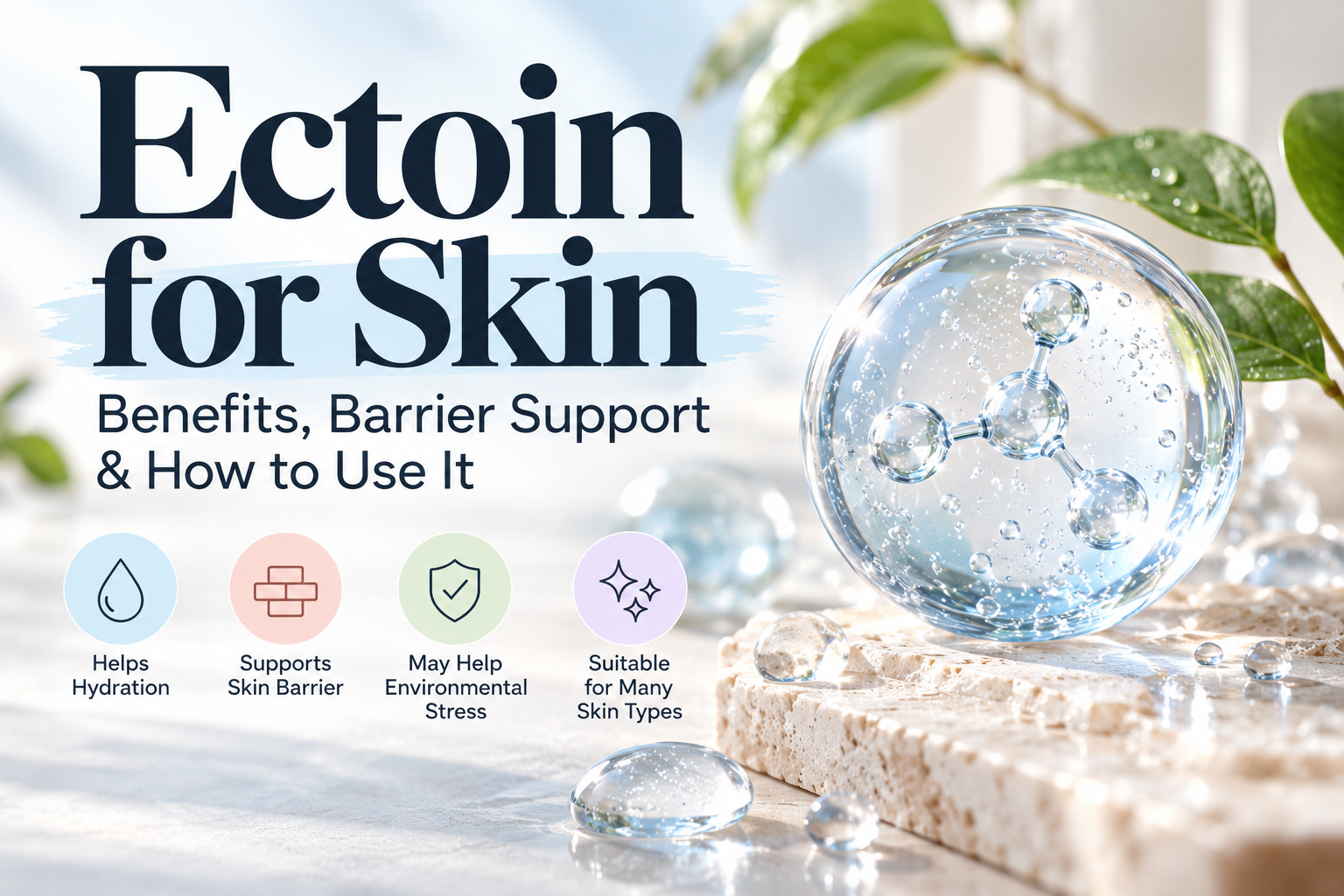
Ectoin for Skin: Benefits, Barrier Support & How to Use It
Ectoin for skin is starting to appear in more moisturizers, serums and barrier-focused skincare products.
It is often described as an ingredient that can protect skin from environmental stress, strengthen the skin barrier, increase hydration and even help prevent signs of aging.
Those are big claims for an ingredient that many people have barely heard of.
So what is ectoin actually doing—and how much of the excitement is supported by evidence?
Ectoin does have interesting research behind it. But as with many newer skincare ingredients, there is an important difference between promising laboratory research, clinical studies using specific ectoin formulations and what we can claim about every ectoin serum on the market.
What Is Ectoin?
Ectoin is a small molecule known as an extremolyte.
It is produced naturally by certain microorganisms that live in stressful environments such as high salinity, heat and dryness. These organisms accumulate ectoin as a compatible solute that helps protect cellular structures under environmental stress.
That origin is one reason ectoin has become interesting in skincare.
But I would be careful with the common marketing shortcut:
“Ectoin protects bacteria in extreme environments, so it protects your skin from everything too.”
That is not how skincare evidence works.
What ectoin does for microorganisms gives researchers a reason to investigate it. We still need studies on skin to know what topical ectoin actually does.
Ectoin for Skin: What Are the Benefits?
The strongest practical reasons I find ectoin interesting are hydration and support for compromised or dry skin.
A systematic review identified six clinical studies involving ectoin-containing topical formulations in people with impaired skin barriers—primarily atopic dermatitis, plus one study involving retinoid dermatitis.
Formulations containing approximately 5.5–7% ectoin were associated with improvements in dryness and some dermatitis-related outcomes.
But there is an important limitation.
These were studies of specific ectoin-containing formulations in people with skin conditions, not proof that every cosmetic ectoin serum will produce the same effects. The review also rated the certainty of individual studies from very low to moderate.
So I would describe the evidence as promising rather than definitive.
Does Ectoin Help the Skin Barrier?
There is reasonable evidence that ectoin-containing formulations can be useful when the skin barrier is compromised, particularly in the clinical contexts studied.
Researchers have investigated changes in dryness, hydration and transepidermal water loss, or TEWL, which measures water escaping through the skin.
But the results have not been perfectly consistent. In the systematic review, hydration was explicitly evaluated in only three of the six included studies, and one study found improvement in TEWL without a corresponding change in measured skin hydration.
That is exactly why I would avoid saying:
“Ectoin repairs your skin barrier.”
A better interpretation is:
Ectoin-containing formulations may support hydration and barrier function, particularly in dry or compromised skin, but the evidence depends on the specific formulation and situation being studied.
If your skin already feels damaged, tight or unusually reactive, I explain the bigger picture in Damaged Skin Barrier? Signs, Causes and How to Repair It.
Does Ectoin Protect Skin From Environmental Stress?
This is where ectoin gets especially interesting—and where marketing can easily get ahead of the evidence.
Laboratory research has investigated ectoin under environmental stressors including UV exposure.
Older cell-based research found protective effects against several UVA-induced cellular changes. More recent research has examined hydration-related pathways and collagen-related processes in human skin cells with and without UVB exposure.
Interesting?
Absolutely.
Proof that an ectoin serum acts as an invisible pollution-and-UV shield on your face?
No.
Much of this evidence comes from cell or laboratory models, so I would not translate it directly into dramatic real-world claims.
And ectoin certainly does not replace sunscreen.
If you use ectoin during the day, you still need appropriate sun protection.
Is Ectoin an Anti-Aging Ingredient?
I would not make “anti-aging” the main reason to buy ectoin.
Recent laboratory research has found interesting effects involving collagen degradation and hydration-related pathways, including experiments performed under UVB exposure.
But those findings are largely mechanistic and cell-based.
That is very different from showing that an ectoin serum visibly reduces wrinkles in large, long-term human clinical trials.
For everyday skincare, I think ectoin makes more sense when viewed as a hydration and skin-comfort ingredient with interesting protective research, rather than as a wrinkle treatment.
Ectoin vs Hyaluronic Acid: What’s the Difference?
This is probably one of the most useful comparisons.
Hyaluronic acid is primarily known as a humectant. In skincare, its main role is helping support hydration by binding water.
Ectoin is different.
It is an extremolyte/osmolyte studied for its interactions with water and biological structures under stress conditions.
So I would not think of ectoin as simply a more advanced version of HA.
They can serve overlapping purposes—particularly hydration—but they are not interchangeable ingredients.
If your main goal is straightforward hydration, a good HA-containing moisturizer or serum may already be enough.
If you are interested in hydration plus an ingredient being investigated for barrier and environmental-stress support, ectoin becomes more interesting.
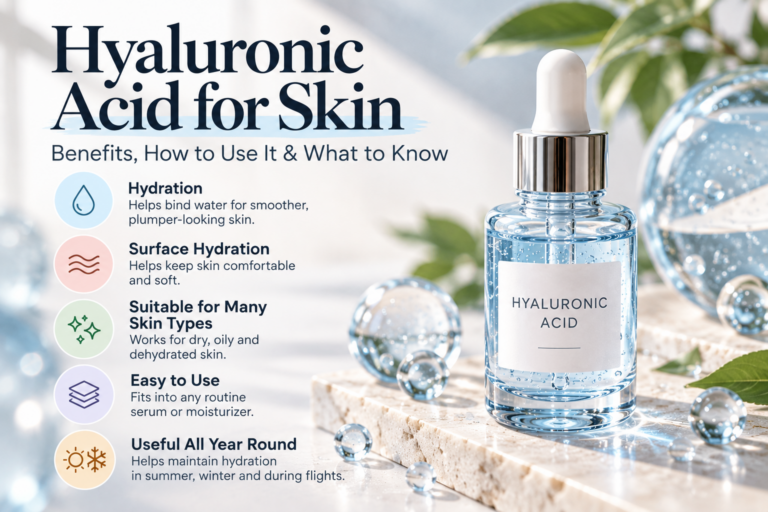
For more on molecular weight, damp-skin application and whether HA can actually make skin drier, see Hyaluronic Acid for Skin: Benefits, How to Use It & What to Know.
Is Ectoin Better Than Hyaluronic Acid?
I would not rank one as universally better.
It depends on what the rest of the product contains and what your skin actually needs.
A beautifully formulated HA moisturizer can be more useful than a poorly formulated ectoin serum.
And an ectoin product can contain HA, glycerin, ceramides or other moisturizing ingredients at the same time.
That makes another point important:
When an ectoin product improves your skin, you cannot automatically attribute every result to ectoin alone.
Skincare products are formulas, not isolated ingredients.
What Percentage of Ectoin Should You Use?
This is another number I would not chase.
Clinical studies included in the systematic review often evaluated formulations containing around 5.5–7% ectoin, but that does not establish 5–7% as the universal ideal concentration for cosmetic skincare.
A recent 2026 randomized split-face study also evaluated a specific 7% ectoin formulation after repeated vascular laser treatments and found differences in several measured skin-response parameters compared with its vehicle. But it was a small, specific post-procedure study—not a universal concentration trial for everyday skincare.
So I would not say:
“Only buy ectoin above 5%.”
We simply do not have enough comparative evidence to establish a single ideal percentage for everyone.
The formulation matters.
Who Might Find Ectoin Interesting?
I would pay particular attention to ectoin if my skin tends to feel:
- dry or dehydrated
- uncomfortable in low-humidity environments
- easily stressed by weather changes
- in need of a simple barrier-focused routine
That does not mean ectoin is necessary for those skin types.
And if you have eczema, dermatitis or another persistent skin condition, cosmetic skincare should not replace appropriate medical care.
For me personally, ingredients like this are most interesting when my skin is exposed to dry environments frequently.
Working in aircraft cabins means I spend a lot of time in low humidity. I still consider my overall routine—hydration plus an appropriate moisturizer—more important than relying on one special ingredient.
Ectoin would be an additional option within that routine, not the foundation of it.
How Should You Use Ectoin?
Ectoin is relatively easy to fit into a skincare routine.
For example:
Morning
Cleanse → Ectoin serum if using one → Moisturizer → Sunscreen
Evening
Cleanse → Ectoin serum → Moisturizer
If ectoin is already inside your moisturizer, you obviously do not need a separate ectoin serum just to say you are using the ingredient.
Personally, I prefer keeping the serum step simple rather than layering several serums at once.
The ingredient I choose for that step can change depending on what my skin needs and whether it is my morning or evening routine.
If you are unsure where serums fit, see How to Layer Skincare Products.
Can You Use Ectoin With Retinol, Vitamin C or Niacinamide?
Generally, ectoin is not treated like an exfoliating acid or retinoid that needs complicated scheduling.
It can potentially fit into routines containing ingredients such as:
- vitamin C
- niacinamide
- retinoids
- hyaluronic acid
In fact, its hydration and skin-comfort role may make it appealing in routines that contain potentially drying actives.
But I would still look at the finished product, not just ectoin.
A serum marketed around ectoin may contain many other ingredients that affect tolerability.
And I would not add four new actives at once simply because they are technically compatible.
Is Ectoin Safe for Sensitive Skin?
Existing clinical research suggests ectoin-containing topical formulations have generally been well tolerated, including studies involving people with compromised skin barriers.
But that does not make every ectoin cosmetic automatically suitable for sensitive skin.
Fragrance, preservatives, botanical extracts and other active ingredients in the finished product can still cause irritation.
If your skin is reactive, the entire ingredient list matters more than seeing “ectoin” on the front of the bottle.
What I Would Look for in an Ectoin Product
I would not choose one simply because the brand claims ectoin is an “extreme environment survival molecule.”
Instead, I would ask:
Is the ectoin concentration disclosed—and does the brand have evidence for the finished formula?
Does the product also contain useful moisturizing or barrier-supporting ingredients?
Is the texture appropriate for my skin and routine?
Are the claims based on human skincare research, or mainly laboratory studies?
And most importantly:
Do I actually need this product?
If my current moisturizer already keeps my skin hydrated and comfortable, I would not add ectoin simply because it is becoming trendy.
The Bottom Line
Ectoin for skin is genuinely interesting—but I would keep expectations realistic.
It is an extremolyte produced by microorganisms that survive stressful environments, and topical ectoin formulations have shown promising results for hydration, dryness and compromised skin barriers.
Laboratory research also suggests interesting protective effects under environmental stress.
But “promising” is different from “proven to protect your face from everything.”
We still need stronger and broader human clinical research, especially for everyday cosmetic use.
I would not replace sunscreen, moisturizer or a sensible skincare routine with ectoin.
Instead, I would see it as another potentially useful ingredient—particularly if hydration, dryness and skin comfort are priorities.
For me, that is actually more interesting than calling it the next miracle ingredient.
A skincare ingredient does not need to do everything to be worth using.