Hyaluronic Acid for Skin: Benefits, How to Use It & What to Know
Hyaluronic acid for skin is one of the most common ways to add hydration to a skincare routine.
Its main purpose sounds simple: hydration.
But the advice around it can be surprisingly confusing.
Should you always apply hyaluronic acid to damp skin? Can it make your skin drier in a dry climate? Is low-molecular-weight HA better because it penetrates deeper? And do you even need an HA serum if your moisturizer already contains it?
Hyaluronic acid can be a useful hydrating ingredient, but you do not need to make it complicated.
Here is what actually matters.
What Is Hyaluronic Acid?
Hyaluronic acid, usually shortened to HA, is a naturally occurring molecule found throughout the body, including the skin.
Despite the word “acid,” it is not an exfoliating acid like glycolic or salicylic acid.
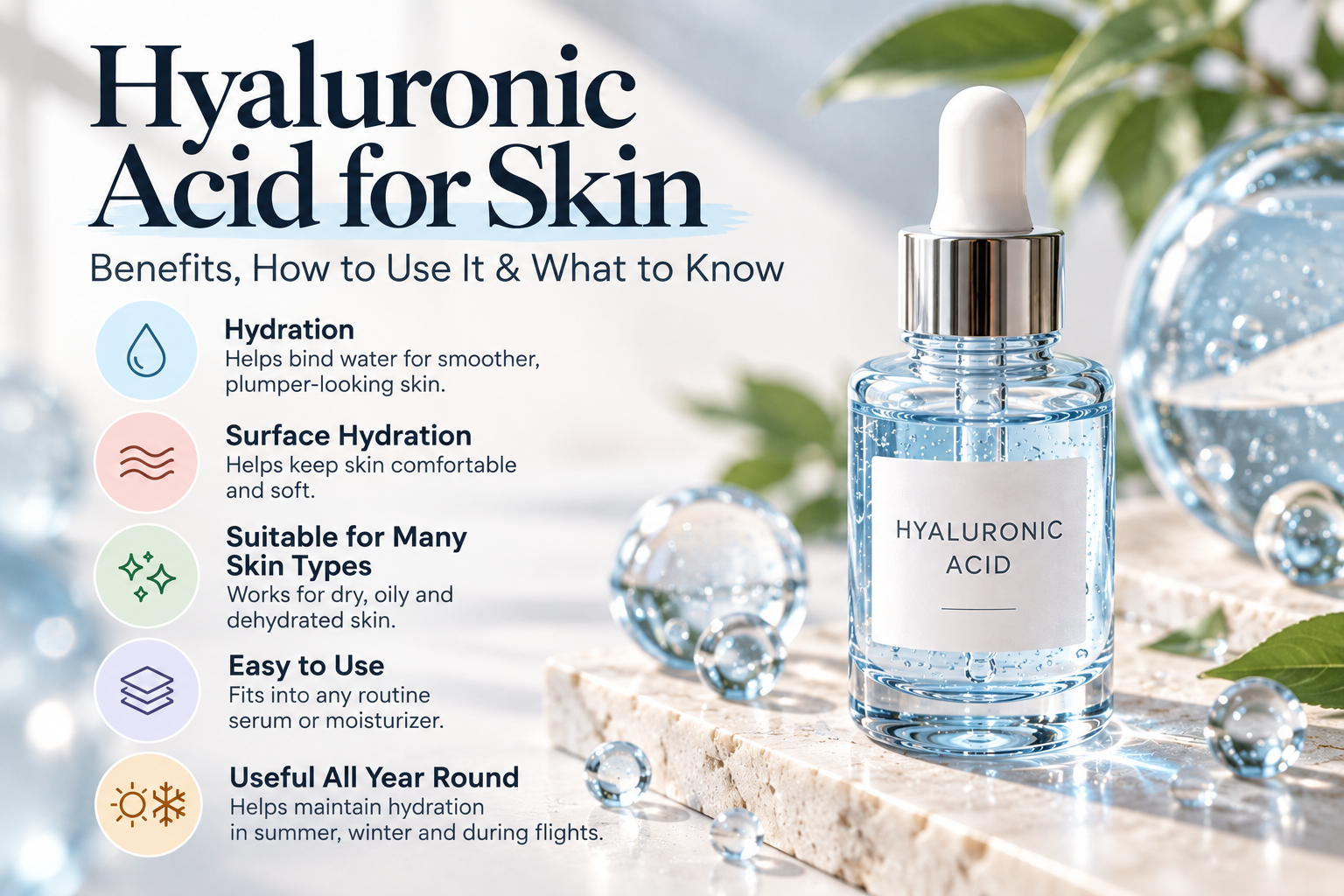
In skincare, HA primarily acts as a humectant, meaning it helps bind water and support hydration.
You may also see ingredients such as sodium hyaluronate or hydrolyzed hyaluronic acid on skincare labels. These can differ in molecular characteristics, which can affect how they behave on the skin.
Hyaluronic Acid for Skin: What Are the Benefits?
The clearest benefit of topical HA is hydration.
It can help increase water content in the outer layers of the skin, which can make skin feel softer, smoother and temporarily plumper. Better hydration can also make dehydration-related fine lines look less noticeable.
Clinical research supports the moisturizing role of topical HA, although results depend on the particular formulation and molecular weight being studied.
A 2024 randomized controlled trial in older adults with dry skin found greater improvement in measured skin hydration with a low-molecular-weight HA moisturizer than with a high-molecular-weight HA moisturizer or the vehicle after four weeks. This finding applies to the formulations and population studied; it does not establish that every low-molecular-weight HA product is better for every skin type.
But that does not mean smaller HA is always better.
High vs Low Molecular Weight Hyaluronic Acid
HA comes in different molecular sizes.
In simplified terms:
High-molecular-weight HA tends to remain closer to the skin surface, where it can contribute to surface hydration and form a hydrating film.
Lower-molecular-weight HA has a greater ability to penetrate into the outer layers of the skin.
This is why some products combine several molecular weights.
But I would not automatically assume that a product advertising “5 types” or “10 types” of HA is better.
And deeper penetration is not automatically better either.
HA does not need to reach the dermis to be useful. Supporting hydration at the skin surface and within the stratum corneum can already be valuable.
The formulation as a whole matters more than simply choosing the smallest molecule or the largest number of HA types.
Should You Apply Hyaluronic Acid to Damp Skin?
Applying HA to slightly damp skin can be a practical way to use it.
Dermatologists commonly recommend applying moisturizer while skin is still damp because it can help trap some of that water and reduce evaporation.
So a simple routine can be:
Cleanse → HA serum → Moisturizer
Your face does not need to be dripping wet, and I would not treat damp skin as a strict requirement for HA to “work.”
More importantly, if you are using a lightweight HA serum, follow it with a moisturizer appropriate for your skin rather than expecting one humectant to do the entire job.
Can Hyaluronic Acid Make Skin Drier in Dry Weather?
You may have heard:
“Never use hyaluronic acid in dry weather because it pulls water out of your skin.”
That is too simplistic.
Low humidity itself can contribute to dryness because water is more easily lost from the skin into the environment. But that is different from proving that topical HA automatically pulls water from deeper skin and makes you drier.
The more useful advice is:
Do not rely on a lightweight HA serum as your entire moisturizing routine in a very dry environment.
This is particularly relevant to me because I spend a lot of time working in extremely dry aircraft cabins.
During long flights and in winter, I pay more attention to hydration because my skin tends to feel the effects of dry environments more easily.
But I do not stop thinking about hydration in summer simply because my skin does not look dry. Well-hydrated skin generally looks smoother and more comfortable, while dryness can make fine lines appear more noticeable.
In warmer weather, especially before makeup, I prefer lightweight hydrating products that settle comfortably into my skin rather than multiple heavy layers.
And during flights or colder months, I may give hydration more attention and adjust my moisturizer depending on how my skin feels.
If flying tends to leave your skin tight or uncomfortable too, I explain the low-humidity issue in Dry Skin After Flying: What to Do Before, During and After a Flight.
Hyaluronic Acid Serum vs Moisturizer: Do You Need Both?
Not necessarily.
If your moisturizer already keeps your skin comfortable and contains humectants such as HA or glycerin, you may not need a separate HA serum.
But if you like adding lightweight hydration before moisturizer, an HA serum can fit easily into that step.
Personally, I prefer keeping the serum part of my routine simple.
Especially when I am going to wear makeup, I care about how well my skincare absorbs and settles. So rather than layering several serums before cream, I usually choose one main serum for that routine.
That does not mean I use the same serum every time.
My morning and evening routines can have different purposes. For example, I tend to use vitamin C in the morning, while my evening serum may focus on a different ingredient.
If you want a closer look at that ingredient, see How to Use Vitamin C Serum.
When hydration is the priority—during winter, frequent flying or whenever my skin feels dehydrated—I can make hydration the focus of that serum step instead.
In summer, I still care about keeping my skin hydrated, but before makeup I usually prefer something lightweight that absorbs and settles well.
Then I follow with a moisturizer suited to my skin and environment.
For me, the goal is not to layer as many products as possible. It is to give each step a purpose and keep the routine simple enough that everything sits comfortably on my skin.
For a simple morning and evening order, see How to Layer Skincare Products.
Can Oily or Dehydrated Skin Use Hyaluronic Acid?
Yes.
Oiliness and dehydration are not opposites. Skin can produce plenty of oil while still feeling tight or lacking water.
I used to think that having oily skin meant I should avoid moisturizer and keep everything as light as possible. Over time, especially after working in dry cabin environments, I became much more aware of the difference between oiliness and dehydration.
A lightweight HA-containing serum or moisturizer can fit comfortably into an oily or combination-skin routine.
But again, HA does not have to be the solution to everything.
For me, the bigger improvement came from paying attention to my overall routine rather than trying to fix dehydration with one ingredient.
If your face often feels oily and tight at the same time, see Oily but Dehydrated Skin: Why Your Face Feels Greasy and Tight.
Is a Higher Percentage of Hyaluronic Acid Better?
Not necessarily.
HA products can differ in:
- molecular weight
- chemical form
- concentration
- formulation
- other moisturizing ingredients
There is no universal cosmetic HA percentage that everyone needs.
So I would not choose a product simply because it advertises the highest percentage.
The same applies to multi-molecular HA. Using different molecular sizes can make sense because they behave differently, but “more types of HA” does not automatically mean a better formula.
How Should You Use Hyaluronic Acid?
You can keep it very simple.
Morning
Cleanse → HA serum if needed → Moisturizer → Sunscreen
Evening
Cleanse → HA serum if needed → Moisturizer
If you use toner or essence, those can come before the serum depending on their texture and your routine.
HA can also generally fit alongside ingredients such as vitamin C, niacinamide, retinoids and azelaic acid. You usually do not need to separate them simply because HA is an “active” ingredient.
What matters more is whether the finished products work well together and whether your skin tolerates the overall routine.
Can Hyaluronic Acid Irritate Skin?
Topical HA is generally well tolerated, but no skincare product is irritation-proof.
Sometimes irritation comes from other ingredients in the finished formula, such as fragrance, preservatives or additional active ingredients rather than HA itself.
If a product repeatedly causes significant burning, redness, itching or worsening irritation, I would stop using it rather than assuming discomfort means it is working.
What I Look for in an HA Product
I would not choose one based only on the biggest percentage or the longest list of HA types.
I would ask:
- Does the texture suit my skin?
- Does it absorb and sit well under the rest of my routine?
- Does my skin actually feel more comfortable when I use it?
- Does the formula contain other useful moisturizing ingredients?
- Do I actually need another hydration step?
That last question is important.
Hyaluronic acid is useful, but you do not necessarily need a dedicated HA serum to have well-hydrated skin.
The Bottom Line
Hyaluronic acid for skin is popular for a good reason: it is a useful and well-established hydrating ingredient.
Different molecular weights behave differently. Larger HA tends to stay closer to the skin surface, while smaller forms have greater penetration potential—but deeper does not automatically mean better.
Applying HA to slightly damp skin can be practical, but it is not a strict requirement.
And the idea that HA automatically “sucks moisture out of your skin” in dry air is an oversimplification.
For me, the most useful approach is much simpler:
Choose hydration that suits your skin and environment, keep the serum step purposeful, and follow with an appropriate moisturizer when you need it.
Especially during winter and long flights, I pay more attention to hydration. In summer or before makeup, I prefer lighter layers that settle well.
Hyaluronic acid can be a useful part of that routine—but it does not need to do the whole job by itself.